Home → Blog → Specials → Navratri 2026: Dates, 9 Goddesses, Colors, Pooja, Fasting and Vijayadashami
Navratri 2026: Dates, 9 Goddesses, Colors, Pooja, Fasting and Vijayadashami
 On September 25, 2026
Overview
Navaratri 2026 (Navratri) begins on Sunday, October 11, and the nine sacred nights continue through October 19. Vijayadashami falls on Tuesday, October 20, 2026. Shardiya Navaratri is one of the most important festivals dedicated to the Divine Mother. The festival celebrates strength, prosperity, wisdom and the victory of Dharma over Adharma.
The word Navratri means "nine nights." During these nine nights, devotees worship the Divine Mother as Durga. In many traditions, they also honor Lakshmi and Saraswati.
Navratri follows different customs across India. North Indian traditions commonly follow the nine forms of Durga called Navadurga. In comparison, many South Indian traditions divide the festival into three phases: Durga, Lakshmi and Saraswati.
Navratri also includes fasting, Goddess Pooja, Golu, Garba, Durga Puja, Kanya Pooja, Saraswati Pooja and Ayudha Pooja. Finally, Vijayadashami completes the festival with victory and new beginnings. You can also explore AstroVed for more Hindu festival, astrology and devotional resources.
Table of Contents
Navratri 2026 Dates and the Important Days from Ghatasthapana to Vijayadashami
Shardiya Navratri 2026 begins on October 11 and continues through October 19. Vijayadashami follows on October 20. Together, these days move from the start of Goddess worship to the final celebration of victory and new beginnings.
| Festival / Observance |
Date in 2026 |
Significance |
| Navratri Begins |
October 11 |
First day of the nine-night Goddess worship |
| Ghatasthapana |
October 11 |
Kalash installation in traditions that follow it |
| Navratri Day 5 |
October 15 |
Panchami period linked with Lalita worship in some traditions |
| Maha Saptami Period |
October 17 to 18 |
Important stage of Durga worship |
| Durga Ashtami |
Around October 19 |
Major day for Durga and Kanya worship |
| Maha Navami |
October 19 |
Final major stage of the nine-night worship |
| Vijayadashami / Dussehra |
October 20 |
Victory, completion and new beginnings |
The 2026 Tithis do not fit neatly into one calendar date each. Some Tithis continue across two sunrise periods. As a result, Ashtami and Navami may appear on different dates in regional Panchangs.
For formal Pooja, Homa, Kanya Pooja and other Tithi-based rituals, follow the local Panchang. It gives timings based on the devotee's location and sunrise.
What Navratri Means and Why Shardiya Navratri Is Celebrated for Nine Nights
Navratri is a nine-night festival that honors Shakti, the Divine Mother. Shakti represents the power to protect, create, nourish, learn and act. Therefore, the festival turns these qualities into nine nights of prayer and devotion.
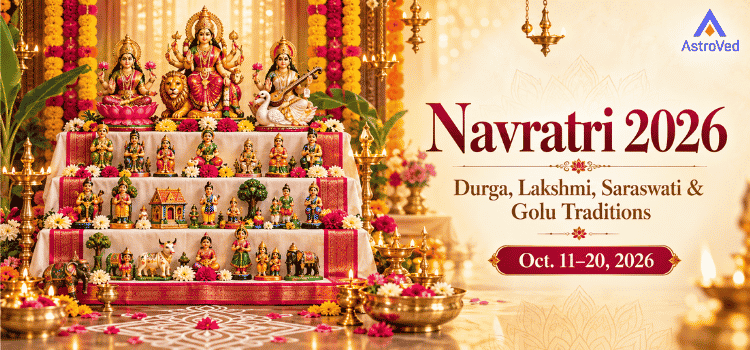 Devotees celebrate Shardiya Navratri during autumn in the Hindu lunar month of Ashwin. It usually falls in September or October. Among the different Navratri periods, Shardiya Navratri has the widest public celebration.
Goddess Durga stands at the center of Shardiya Navratri. She represents Divine strength that protects Dharma. In addition, devotees connect Durga with the courage to overcome fear, ego, anger and ignorance.
Different regions follow their own customs during these nine nights. For example, AstroVed's guide to Navratri traditions and significance explains how these practices vary across India.
Devotees celebrate Shardiya Navratri during autumn in the Hindu lunar month of Ashwin. It usually falls in September or October. Among the different Navratri periods, Shardiya Navratri has the widest public celebration.
Goddess Durga stands at the center of Shardiya Navratri. She represents Divine strength that protects Dharma. In addition, devotees connect Durga with the courage to overcome fear, ego, anger and ignorance.
Different regions follow their own customs during these nine nights. For example, AstroVed's guide to Navratri traditions and significance explains how these practices vary across India.
The Story of Navratri Explains Why Goddess Durga Is Worshipped for Nine Nights
The best-known Navratri story is the battle between Goddess Durga and Mahishasura. Hindu tradition describes Mahishasura as a powerful Asura who disturbed the Devas and the balance of the worlds.
The Divine powers then united and took the form of Goddess Durga. The Gods gave her their powers and weapons. After that, Durga entered battle with Mahishasura.
Tradition says the battle continued for nine nights before Durga defeated Mahishasura. The tenth day celebrates her victory as Vijayadashami. Therefore, the festival links nine nights of worship with a final day of victory.
The story also carries an inner spiritual meaning. Mahishasura can represent ego, anger, greed, jealousy, fear and ignorance. In contrast, Durga represents the courage needed to overcome these tendencies.
Another tradition connects Navratri with the Ramayana. In this version, Lord Rama worships Goddess Durga before his battle with Ravana. Later, Dussehra remembers Rama's victory over Ravana.
AstroVed's Navaratri legends explain the different stories connected with the festival.
Different regions may focus on different stories. However, the central message remains similar: Dharma overcomes Adharma, and spiritual strength helps a person move beyond inner limits.
The Nine Forms of Durga, or Navadurga, Represent Nine Qualities of Divine Shakti
Navadurga means the nine forms of Goddess Durga that devotees honor across the nine days of Navratri. Each form expresses a different quality of Divine Shakti. Together, the nine forms create a journey from stability to wisdom.
| Navadurga |
Simple Meaning |
What the Form Represents |
| Shailputri |
Daughter of the Mountain |
Stability, grounding and a strong beginning |
| Brahmacharini |
The devoted seeker |
Discipline, patience and devotion |
| Chandraghanta |
Protective Goddess form |
Courage, alertness and protection |
| Kushmanda |
Creative cosmic energy |
Vitality, light and creation |
| Skandamata |
Mother of Skanda |
Care, protection and motherly strength |
| Katyayani |
Warrior Goddess |
Courage, action and determination |
| Kalaratri |
Fierce night form |
Protection and removal of fear |
| Mahagauri |
Radiant and pure form |
Peace, purity and inner calm |
| Siddhidatri |
Giver of Siddhis |
Completion, wisdom and spiritual growth |
The nine Goddesses are not nine unrelated deities. Instead, Navadurga presents nine expressions of the same Divine Mother. The sequence starts with stability and ends with wisdom and fulfillment.
Regional traditions may follow different Goddess sequences. Still, the Shailputri-to-Siddhidatri sequence remains one of the most widely followed. For more detail, read AstroVed's nine forms of Durga.
Navaratri 2026 Day 1 to Day 9: Goddess, Color, Bhog and Meaning
Each day of the widely followed Navadurga tradition honors one form of Goddess Durga. A traditional color also goes with each calendar day. In addition, several North Indian traditions follow a day-specific Bhog sequence.
| Day |
Date |
Goddess |
2026 Color |
Traditional Bhog |
Main Quality |
| Day 1 |
Oct. 11 |
Shailputri |
Orange |
Ghee |
Stability |
| Day 2 |
Oct. 12 |
Brahmacharini |
White |
Sugar |
Discipline |
| Day 3 |
Oct. 13 |
Chandraghanta |
Red |
Kheer |
Courage |
| Day 4 |
Oct. 14 |
Kushmanda |
Royal Blue |
Malpua |
Vitality |
| Day 5 |
Oct. 15 |
Skandamata |
Yellow |
Banana |
Care |
| Day 6 |
Oct. 16 |
Katyayani |
Green |
Honey |
Determination |
| Day 7 |
Oct. 17 |
Kalaratri |
Grey |
Jaggery |
Fearlessness |
| Day 8 |
Oct. 18 |
Mahagauri |
Purple |
Coconut |
Purity |
| Day 9 |
Oct. 19 |
Siddhidatri |
Peacock Green |
Sesame |
Completion |
The 2026 color order is Orange, White, Red, Royal Blue, Yellow, Green, Grey, Purple and Peacock Green. Wearing the day's color is a popular custom. However, Navratri worship does not require it.
The traditional Bhog sequence can vary by family and region. Therefore, devotees may offer fruit, sweets or simple homemade vegetarian food when a specific Bhog is not available.
For more detail on the yearly color tradition, see AstroVed's Navratri colors guide.
The Nine Nights Also Follow a Durga, Lakshmi and Saraswati Journey in South Indian Tradition
Many South Indian Navratri traditions honor Durga during the first three days, Lakshmi during the next three and Saraswati during the final three. As a result, the nine nights follow a clear spiritual path.
| Navratri Phase |
Goddess |
Main Focus |
| Days 1 to 3 |
Durga |
Strength, protection and inner cleansing |
| Days 4 to 6 |
Lakshmi |
Prosperity, nourishment and well-being |
| Days 7 to 9 |
Saraswati |
Knowledge, clarity and wisdom |
| Day 10 |
Vijayadashami |
Victory and new beginnings |
Durga represents the strength needed to remove what blocks progress. Therefore, the first three days focus on courage, protection and inner cleansing.
Lakshmi represents prosperity and the resources needed to grow. Next, the middle three days focus on abundance, nourishment and family well-being.
Saraswati represents knowledge and the wisdom needed to use resources well. Finally, the last three days focus on learning, communication, creativity and clarity.
This three-stage journey can be understood as strength, prosperity and wisdom. First, Navratri clears what limits us. Next, it strengthens what supports us. Finally, it develops the wisdom needed to move forward.
Navratri Pooja at Home Can Be Simple, Consistent and Meaningful Across All Nine Days
Navratri Pooja at home does not need to be elaborate. A clean prayer space, lamp, flowers, simple Naivedyam and regular prayer are enough for a meaningful home observance.
- Clean the Pooja space. Place an image or idol of Goddess Durga or the Goddess form followed by your family.
- Begin with Ghatasthapana if your tradition follows it. You may install a Kalash on the first day.
- Light a lamp every day. Keep the prayer space peaceful and clean.
- Offer flowers and Kumkum. Use fresh offerings that are easily available.
- Offer simple Bhog or Naivedyam. Fruit, sweets or homemade vegetarian food are suitable.
- Remember the Goddess of the day. Follow Navadurga or the Durga-Lakshmi-Saraswati tradition used in your home.
- Chant a Devi mantra or prayer. A familiar Durga, Lakshmi, Saraswati or Lalita prayer can be used.
- Read a short sacred passage or Goddess names. Keep the worship brief but regular.
- Perform Aarti and conclude with gratitude. End the Pooja calmly and respectfully.
Consistency matters more than making the Pooja complicated. Therefore, a devotee with limited time can perform a short morning or evening Pooja on all nine days.
Navratri Fasting Supports Prayer, Discipline and Control of the Senses
Navratri fasting is a devotional practice, not only a food restriction. The practice helps simplify daily habits and creates more space for prayer and self-control.
Fasting rules differ across India. For example, some devotees avoid regular grains, non-vegetarian food, alcohol, onion, garlic and heavy food.
Foods used during fasting also vary by region. Some devotees take fruits, milk, yogurt, potatoes, nuts, Sama rice, Kuttu flour or Singhara flour.
Some devotees fast for all nine days, while others fast only on important days. In addition, some take one meal a day, while others follow a simple Sattvic vegetarian diet.
The spiritual side of fasting also includes control over speech and behavior. Therefore, avoiding anger, unnecessary arguments and distractions can matter as much as changing the diet.
A strict fast is not suitable for everyone. Children, older adults, pregnant people and anyone managing a health condition should choose a safe form of observance.
Shardiya, Chaitra and Gupt Navratri Are Different Seasonal Forms of Goddess Worship
Navratri is not limited to one festival in the year. Hindu tradition recognizes Navratri periods in different seasons. However, Shardiya and Chaitra Navratri are the most widely celebrated.
| Type of Navratri |
Approximate Period |
Main Character |
| Chaitra Navratri |
March or April |
Spring Navratri, closely connected with Rama Navami |
| Ashadha Gupt Navratri |
June or July |
More private or specialized Goddess worship |
| Shardiya Navratri |
September or October |
Most widely celebrated Navratri, followed by Vijayadashami |
| Magha Gupt Navratri |
January or February |
Another less public form of Goddess worship |
Chaitra Navratri takes place in spring, while Shardiya Navratri takes place in autumn. Both festivals honor Divine Shakti. However, Shardiya Navratri has larger public celebrations in many regions.
To understand the spring festival, you can also explore AstroVed's Vasant Navratri page.
Navaratri Golu Brings Goddess Worship, Stories, Music and Community Together in South India
Navaratri Golu is a South Indian tradition in which families display dolls and sacred figures on stepped platforms. The tradition is especially popular in Tamil Nadu and Telugu-speaking regions.
Golu may include Gods, Goddesses, saints, animals, village scenes and stories from Hindu tradition. In addition, families commonly use odd-numbered steps such as 3, 5, 7 or 9.
Golu brings prayer, storytelling, music and community together. Families light lamps, offer Sundal or sweets, sing devotional songs and invite friends and relatives.
For more details, AstroVed's Navaratri Golu guide explains the tradition and common Golu practices.
Tamil Navratri also gives special importance to Saraswati Pooja and Ayudha Pooja. Families place books, musical instruments, tools and work equipment for worship. In this way, the practice expresses gratitude for knowledge, skill and work.
Maha Navami 2026 Marks the Final Stage of the Nine-Day Goddess Worship
Maha Navami is the ninth Tithi of Navratri and marks the final stage of the nine-day Goddess worship. In the Navadurga tradition, devotees connect Navami with Siddhidatri.
Special Devi worship may also take place on Maha Navami. Depending on regional tradition, devotees may perform Navami Homa, Saraswati Pooja or Ayudha Pooja.
In 2026, Maha Navami falls within the October 19 Navratri observance. Exact Tithi timing may vary by location. Therefore, devotees should follow their local Panchang for formal rituals.
Maha Navami prepares the way for Vijayadashami. The following day celebrates victory, completion and new beginnings.
Vijayadashami and Dussehra 2026 Celebrate Victory and New Beginnings
Vijayadashami falls on Tuesday, October 20, 2026. The day completes the Navratri period.
Different Hindu traditions explain Vijayadashami through different stories. Goddess traditions remember Durga's victory over Mahishasura. Meanwhile, the Ramayana tradition remembers Rama's victory over Ravana.
Vijayadashami and Dussehra belong to the same broad tenth-day festival. However, regional customs differ. Some regions focus on Goddess Durga, while others place greater emphasis on Rama and Ravana.
South Indian families also treat Vijayadashami as an important day for learning and the arts. For example, children may begin education through Vidyarambham. Students may also begin or resume music, dance and academic study.
Vijayadashami turns the nine-night spiritual journey toward action. As a result, the day carries the strength, prosperity and wisdom developed during Navratri into a fresh beginning.
AstroVed's Navaratri 2026 Worship Extends the Nine-Night Journey Through 27 Goddess Forms
AstroVed's Navaratri 2026 program follows the progression from Durga to Lakshmi to Saraswati. Across nine nights, the program invokes 27 Goddess forms through nine daily Homas with Moola Mantra chanting.
| Day |
Date |
Forms Invoked in AstroVed's 2026 Program |
| 1 |
Oct. 11 |
Shailaputri, Kushmanda, Skandamata |
| 2 |
Oct. 12 |
Brahmacharini, Katyayani, Kalaratri |
| 3 |
Oct. 13 |
Chandraghanta, Mahagauri, Siddhidatri |
| 4 |
Oct. 14 |
Adi Lakshmi, Dhana Lakshmi, Dhanya Lakshmi |
| 5 |
Oct. 15 |
Gaja Lakshmi, Santana Lakshmi, Dhairya Lakshmi |
| 6 |
Oct. 16 |
Vijaya Lakshmi, Vidya Lakshmi, Aishwarya Lakshmi |
| 7 |
Oct. 17 |
Vaani Devi, Vagvadini, Bharati |
| 8 |
Oct. 18 |
Savitri, Gayatri Devi, Brahmi Saraswati |
| 9 |
Oct. 19 |
Neela Saraswati, Gnana Saraswati, Maha Saraswati |
| Vijayadashami |
Oct. 20 |
Goddess Chandi |
This 27-form sequence is AstroVed's 2026 worship framework. It differs from the standard Navadurga sequence, where devotees honor one Durga form on each day.
The program also includes special Goddess rituals during Navratri. These include Goddess Abishekam, Archana, Sri Chakra Kum-Kum Archana, Lalita Sahasranama Homa, Pratyangira Devi Homa and Kanya Pooja.
Finally, Vijayadashami concludes AstroVed's nine-night journey with Goddess Chandi. Devotees who wish to take part can explore the AstroVed Navaratri 2026 worship program.
Conclusion
Navratri 2026 begins on October 11 and continues through October 19. Vijayadashami follows on October 20.
The nine nights honor different aspects of Divine Shakti. In addition, the festival includes Navadurga worship, the Durga-Lakshmi-Saraswati tradition, fasting, Golu, Saraswati Pooja and Ayudha Pooja.
AstroVed's 2026 Navaratri worship follows this progression through 27 forms of Durga, Lakshmi and Saraswati. Finally, the journey concludes with Goddess Chandi on Vijayadashami.
Frequently Asked Questions About Navratri 2026
What is Navratri and When is Navratri in 2026?
Navratri is a nine-night Hindu festival that honors Shakti, the Divine Mother. Devotees worship different forms of the Goddess through prayer, Pooja, fasting and regional traditions. Shardiya Navratri begins on October 11, 2026. The nine sacred nights continue through October 19.
When is Maha Navami in 2026?
Maha Navami falls within the October 19, 2026 Navratri observance. However, exact Navami Tithi timing varies by location. Therefore, formal rituals should follow the local Panchang.
When is Vijayadashami in 2026?
Vijayadashami falls on Tuesday, October 20, 2026. It completes the Navratri period and represents victory and new beginnings.
When is Dussehra in 2026?
Dussehra falls on October 20, 2026. Dussehra and Vijayadashami belong to the same broad tenth-day festival. However, regional stories and customs differ.
Who are the nine Goddesses of Navratri?
Navadurga includes nine widely followed forms: Shailputri, Brahmacharini, Chandraghanta, Kushmanda, Skandamata, Katyayani, Kalaratri, Mahagauri and Siddhidatri.
What are the nine Navratri colors in 2026?
For 2026, the colors are Orange, White, Red, Royal Blue, Yellow, Green, Grey, Purple and Peacock Green. This sequence runs from October 11 through October 19.
What is the difference between Chaitra and Shardiya Navratri?
Chaitra Navratri occurs during spring, while Shardiya Navratri occurs during autumn. Both honor Divine Shakti. However, Shardiya Navratri has larger public celebrations in many regions.
What is Navaratri Golu?
Navaratri Golu is a South Indian tradition in which families arrange dolls and sacred figures on stepped displays. It is especially popular in Tamil Nadu. In addition, families often include lamps, offerings, songs and visits from friends and relatives.- dussehra
- Navaratri
- Navaratri 2026
- Nine nights
- Nine Nights of Goddess
- vijayadashami


 The item has been added to your cart.


