

 The item has been added to your cart.
Rahu Ketu Pooja: Benefits, Dosha, Procedure & Temples
 On October 23, 2026
Overview
Rahu and Ketu are two important shadow points in Vedic astrology. They are not physical planets. Instead, they are calculated points connected with the paths of the Sun and Moon. Rahu is linked with ambition, desire, change and unfamiliar experiences. Ketu is linked with detachment, past karma, intuition and spiritual understanding. When Rahu or Ketu creates a difficult influence in the birth chart, traditional astrology may suggest Pooja, Homa or another remedy. However, the right remedy depends on the actual horoscope. The placement, planetary period and type of Dosha should be understood first.🪔
Seek traditional Rahu or Ketu remedies based on the planetary influence shown in your horoscope.
Explore Rahu Homa → Explore Ketu Homa →Table of Contents
| 1 | Rahu, Ketu & Their Story |
| 2 | Effects & Doshas |
| 3 | Rahu Ketu Pooja & Benefits |
| 4 | Procedure & Remedies |
| 5 | Temples & Poojas |
| 6 | Rahu Ketu FAQs |
Who Are Rahu and Ketu?
Rahu and Ketu are two calculated shadow points in Vedic astrology. They form where the paths of the Sun and Moon cross. Astrology also calls them lunar nodes, meaning calculated shadow points rather than physical planets. Rahu and Ketu always remain opposite each other in a birth chart. Together, they form an important karmic axis.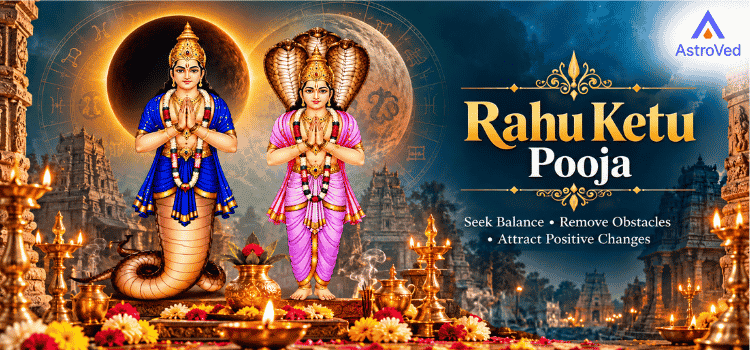 Rahu is commonly associated with desire, ambition and expansion. It can increase the urge to achieve, explore or experience something new. Ketu has a different nature. It is linked with detachment, past experiences, intuition and spiritual understanding.
Therefore, neither Rahu nor Ketu is always negative. Their results depend on the houses they occupy, the planets connected with them and the running planetary period.
The Story of Rahu and Ketu
The traditional story of Rahu and Ketu comes from Samudra Manthan, the churning of the cosmic ocean. The Devas and Asuras churned the ocean to obtain Amrita, the nectar of immortality. When the nectar appeared, Lord Vishnu took the form of Mohini. He then began distributing the nectar among the Devas. An Asura named Svarbhanu disguised himself and sat among them. His intention was to receive the nectar. However, Surya and Chandra recognized him and alerted Lord Vishnu. Lord Vishnu then used his Sudarshana Chakra to separate Svarbhanu's head from his body. By that time, Svarbhanu had already tasted the nectar. Therefore, both parts remained immortal. The head became Rahu. The remaining body became Ketu. This story also explains their traditional connection with eclipses. Rahu and Ketu are symbolically associated with obscuring the Sun and Moon.Rahu vs Ketu
Rahu and Ketu work together as one axis. However, they represent very different experiences.| Rahu | Ketu |
|---|---|
| Represents the head of the serpent | Represents the body or tail of the serpent |
| Linked with desire and ambition | Linked with detachment and past karma |
| Encourages expansion and experience | Encourages reflection and release |
| May increase material attachment | May reduce interest in material matters |
| Can create obsession or confusion when difficult | Can create uncertainty or detachment when difficult |
| May support ambition and unusual success | May support intuition and spiritual growth |
Rahu Ketu Effects in the Birth Chart and Doshas
Rahu and Ketu can give both supportive and challenging results in a birth chart. A favorable Rahu may support ambition, courage, innovation and success in unusual situations. In contrast, a difficult Rahu may increase confusion, obsession, impulsiveness or dissatisfaction. A favorable Ketu may support intuition, research and spiritual understanding. However, a difficult Ketu may create uncertainty, isolation or lack of direction. The planets connected with Rahu and Ketu also matter. Their influence may change depending on conjunctions, houses and planetary periods. For this reason, the complete horoscope is more important than one Rahu or Ketu placement.Rahu Ketu Dosha and Afflictions
The term "Rahu Ketu Dosha" is often used broadly. However, not every difficult Rahu-Ketu influence is the same Dosha. Different horoscope combinations can create different types of concerns.Unfavorable Rahu or Ketu Placement
Rahu or Ketu may become challenging because of their house, sign or connection with other planets. The area of life affected depends on the complete horoscope.Rahu or Ketu Dasha and Bhukti
The influence of Rahu or Ketu may become stronger during their major or minor planetary periods. However, a Rahu Dasha or Ketu Dasha is not automatically negative. The results depend on how these planets function in the individual chart.Kala Sarpa Dosha
Kala Sarpa Dosha is linked with a specific Rahu-Ketu arrangement in the birth chart. Traditional astrology connects it with delays, repeated obstacles or karmic challenges. However, Kala Sarpa Dosha should be identified from the actual horoscope. General life problems alone do not confirm its presence.Grahana Dosha
Grahana Dosha is connected with a close relationship between the Sun or Moon and Rahu or Ketu. The word Grahana means eclipse. Therefore, this Dosha has a traditional connection with Rahu and Ketu obscuring the Sun or Moon.Sarpa or Naga Dosha
Some astrological traditions also connect certain Rahu-Ketu combinations with Sarpa or Naga Dosha. Repeated problems in marriage, career or finances do not automatically prove that a person has this Dosha. Therefore, the horoscope should be examined before choosing a remedy. Check if you have naga doshaWhat Is Rahu Ketu Pooja?
Rahu Ketu Pooja is traditional planetary worship performed to reduce difficult Rahu and Ketu influences and seek greater balance. The exact form of worship depends on the condition shown in the horoscope. Some devotees may need combined Rahu-Ketu worship. Others may require only Rahu Pooja, Ketu Pooja or a more specific Dosha remedy. Rahu Ketu Pooja may include Sankalpam, Navagraha worship, mantra chanting, Archana, traditional offerings and Aarti. A more elaborate remedy may also include Homa. During the fire ritual, priests chant prescribed mantras and make traditional offerings into the sacred fire. Explore poojas for your problemsWho Should Consider Rahu Ketu Pooja?
Rahu Ketu Pooja may be considered when the birth chart shows a difficult influence from Rahu or Ketu. An astrologer may suggest the worship during a challenging Rahu or Ketu Dasha or Bhukti. It may also be considered when the horoscope shows Kala Sarpa Dosha, Grahana Dosha or another condition involving Rahu and Ketu. Some devotees seek Rahu-Ketu remedies when repeated problems affect marriage, career, business or personal progress. However, these problems can have many causes. Therefore, the birth chart should first show whether Rahu, Ketu or another planet is mainly responsible.Traditional Benefits of Rahu Ketu Pooja
Rahu Ketu Pooja is traditionally performed to seek balance during difficult planetary influences. Devotees may pray for:- relief from repeated obstacles and delays
- greater mental clarity
- stability during difficult planetary periods
- progress in personal and professional life
- greater harmony in relationships
- relief from traditional Kala Sarpa or Naga Dosha effects
- protection from confusing influences
- greater spiritual awareness
Rahu Ketu Pooja Procedure and Remedies
There is no single procedure for every Rahu Ketu Pooja. Temple Pooja, Archana and Homa may follow different traditions. However, a priest-performed remedy may follow a general sequence.- The priest first prepares and purifies the worship area.
- Next, Sankalpam is performed with the devotee's name, birth star and purpose of the worship.
- Lord Ganesha may then be invoked before the main planetary prayers.
- After that, Navagraha prayers may be offered.
- Rahu and Ketu are invoked through prescribed mantras and prayers.
- The priest offers flowers and other traditional materials during the worship.
- If a Homa is included, prescribed offerings are placed into the sacred fire with mantra chanting.
- Finally, the ritual concludes with prayers and Aarti.
Rahu Remedy vs Ketu Remedy
Rahu and Ketu remedies can differ because these two shadow planets represent different astrological influences.| Rahu Remedy | Ketu Remedy |
|---|---|
| Focuses on difficult Rahu influences | Focuses on difficult Ketu influences |
| Rahu Pooja or Rahu Homa may be performed | Ketu Pooja or Ketu Homa may be performed |
| Durga worship is traditionally linked with Rahu remedies | Ganesha worship is traditionally linked with Ketu remedies |
| Rahu mantra chanting may be prescribed | Ketu mantra chanting may be prescribed |
| May be considered during difficult Rahu Dasha or Bhukti | May be considered during difficult Ketu Dasha or Bhukti |
| Traditionally seeks balance in excessive desire or confusion | Traditionally seeks balance in detachment or uncertainty |
Temples and Poojas for Rahu and Ketu Worship
Traditional Rahu and Ketu remedies may include temple Pooja, Archana or Homa. The appropriate worship depends on the planetary condition shown in the horoscope. Common Rahu-Ketu remedy options include:- Rahu Pooja at Thirunageswaram
- Ketu Pooja at Keezhperumpallam
- Rahu-Ketu worship at traditional Powerspots
- Rahu Homa
- Ketu Homa
- Durga Homa for difficult Rahu influences
- Ganesha Homa for difficult Ketu influences
- Kala Sarpa Dosha remedial worship when relevant
🪔
Seek traditional Rahu or Ketu remedies based on the planetary influence shown in your horoscope.
Explore Rahu Homa → Explore Ketu Homa →


