108 Divya Desam: Temples, Significance, Pilgrimage & Blessings
 On September 17, 2026
108 Divya Desam - the Vishnu Temples
Overview
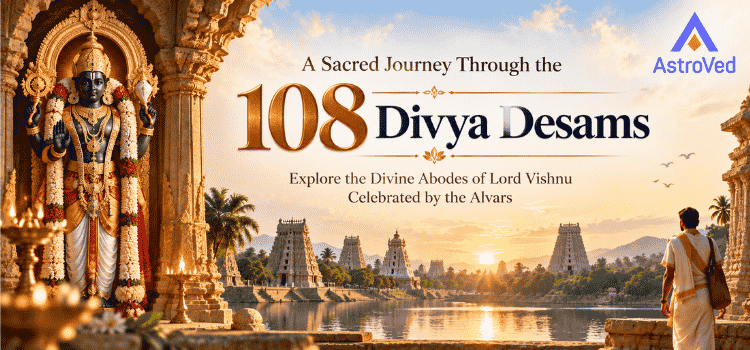
The 108 Divya Desams are sacred places of Vishnu celebrated by the 12 Alvars in the Naalayira Divya Prabandham. Each Divya Desam has its own form of Vishnu, sacred identity and devotional significance, making the 108 sites an important part of the Sri Vaishnava tradition.
The Divya Desam journey brings together pilgrimage, Vishnu worship and different prayer intentions linked with areas such as prosperity, health, family, relationships, career, Dharma and spiritual growth.
AstroVed’s 108 Divya Desam Blessings Program extends this journey for devotees who may not be able to visit every sacred Powerspot in person. Through Sankalpam, the devotee’s name, Birth Star and prayer intentions can be included in worship that progresses across the Divya Desams.
Table of Content
What Is Divya Desam?
A Divya Desam is one of the 108 sacred places or temples of Vishnu honored by the 12 Alvars. These poet-saints of the Sri Vaishnava tradition praised Vishnu in the Naalayira Divya Prabandham, a respected collection of approximately 4,000 Tamil devotional hymns known as the Tamil Veda.
 A sacred place is recognized as a Divya Desam through its connection with the Alvars. An Alvar experienced Vishnu’s Divine presence there and composed hymns praising the particular form worshipped at that Powerspot.
This Alvar connection gives each Divya Desam its own devotional identity. It also distinguishes the 108 Divya Desams from the wider tradition of Vishnu temples.
A sacred place is recognized as a Divya Desam through its connection with the Alvars. An Alvar experienced Vishnu’s Divine presence there and composed hymns praising the particular form worshipped at that Powerspot.
This Alvar connection gives each Divya Desam its own devotional identity. It also distinguishes the 108 Divya Desams from the wider tradition of Vishnu temples.
Origin of 108 Divya Desams
The 108 Divya Desams originated through the devotional experiences and hymns of the Alvars. As the Alvars worshipped Vishnu at different sacred places, they sang about the distinct forms of Vishnu and Lakshmi they experienced there.
These hymns were preserved in the Naalayira Divya Prabandham. The sacred places praised through them became a distinct spiritual network within the Sri Vaishnava tradition.
The 108 Divya Desam temples are therefore united by more than geography or architecture. They share a devotional lineage preserved through the hymns of the Alvars.
Significance of 108 Divya Desams
The tradition recognizes 108 Divya Desams, with each representing a distinct sacred expression of Vishnu worship. AstroVed also gives the number 108 a spiritual interpretation through:
9 planetary forces × 12 dimensions of human life = 108 sacred alignments.
The nine planetary influences are associated with qualities such as purpose, mind, courage, wisdom, relationships and liberation.
The 12 dimensions of life cover areas such as wealth, home, health, family, career, Dharma and spiritual freedom.
This 9 × 12 framework explains the symbolic significance AstroVed gives to the number 108. It is a spiritual interpretation of the established Divya Desam tradition, rather than the historical origin of the 108 Divya Desam list.
What Are the 108 Divya Desam Temples?
The 108 Divya Desam temples are the sacred abodes of Vishnu celebrated by the Alvars in the Naalayira Divya Prabandham. Each Divya Desam is associated with a distinct form and name of Vishnu, giving every sacred place its own devotional identity.
Of the 108 Divya Desams, 106 are associated with earthly sacred places across India and Nepal. Thiruppaarkadal and Thiru Paramapadam are regarded as celestial Divya Desams.
Across these sacred places, Vishnu is worshipped under different names and in different forms. These include standing, seated and reclining forms, each carrying its own devotional significance.
Geographical Distribution of the 108 Divya Desams
Most of the 108 Divya Desams are concentrated in South India, particularly Tamil Nadu and Kerala, while others are located in Andhra Pradesh, Uttar Pradesh, Uttarakhand, Gujarat and Nepal.
For a modern reader planning a 108 Divya Desam tour, classifying them by their present-day location makes the list easier to understand.
| Present-Day Location |
Divya Desams |
| Tamil Nadu |
84* |
| Kerala |
11* |
| Uttar Pradesh |
4 |
| Uttarakhand |
3 |
| Andhra Pradesh |
2 |
| Gujarat |
1 |
| Nepal |
1 |
| Celestial Divya Desams |
2 |
| Total |
108 |
108 Divya Desam List
The table below presents the 108 Divya Desam list by present-day location, along with the principal name of Vishnu associated with each sacred place. The Divya Desams in,
TamilNadu
Based on present-day location, 84 Divya Desams are in Tamil Nadu, making it the largest concentration of Divya Desam sacred sites. They extend from Tiruchirappalli and the Kaveri region to Kanchipuram, Chennai, Madurai, Tirunelveli and Kanyakumari.
| Divya Desam |
Vishnu's Name |
Place |
Divya Desam |
Vishnu's Name |
Place |
| Srirangam |
Ranganathar |
Tiruchirappalli |
Uraiyur |
Azhagiya Manavalan |
Tiruchirappalli |
| Thirukarambanur / Uthamar Kovil |
Purushothaman |
Tiruchirappalli |
Thiruvellarai |
Pundarikakshan |
Tiruchirappalli |
| Thiru Anbil |
Vadivazhagiya Nambi |
Tiruchirappalli |
Koviladi |
Appakudathan |
Thanjavur |
| Thirukkandiyur |
Hara Saabha Vimochana Perumal |
Thanjavur |
Thirukkoodalur |
Vaiyam Katha Perumal |
Thanjavur |
| Kabisthalam |
Gajendra Varadan |
Thanjavur |
Thirupullabhoothangudi |
Valvil Raman |
Thanjavur |
| Thiru Aadanoor |
Aandu Alakkum Aiyan |
Thanjavur |
Thirukkudanthai |
Aravamudhan |
Kumbakonam |
| Thiruvinnagar |
Oppiliappan |
Thanjavur |
Thirunaraiyur |
Naraiyur Nambi |
Thanjavur |
| Thirucherai |
Saranathan |
Thanjavur |
Thirukkannamangai |
Bhaktavatsalan |
Tiruvarur |
| Thirukkannapuram |
Sowrirajan |
Nagapattinam |
Thirukkannangudi |
Shyamala Meni Perumal |
Nagapattinam |
| Thirunagai |
Soundararaja Perumal |
Nagapattinam |
Thanjai Mamani Koil |
Neelamegha Perumal |
Thanjavur |
| Nandipura Vinnagaram |
Jagannathan |
Thanjavur |
Thiruvelliyangudi |
Kola Valvilli Raman |
Thanjavur |
| Therazhundur |
Amaruviyappan |
Mayiladuthurai |
Thiruchirupuliyur |
Arulmaakadal Perumal |
Tiruvarur |
| Thalaichanga Nanmathiyam |
Naanmadiya Perumal |
Mayiladuthurai |
Thiru Indalur |
Parimala Rangan |
Mayiladuthurai |
| Thirukkavalampadi |
Gopala Krishnan |
Thirunangur |
Kazheesirama Vinnagaram |
Thadalan |
Sirkazhi |
| Thiruarimeya Vinnagaram |
Kudamadu Koothan |
Thirunangur |
Thiruvan Purushothamam |
Purushothaman |
Thirunangur |
| Semponsei Koil |
Perarulalan |
Thirunangur |
Thirumanimadam |
Narayana Perumal |
Thirunangur |
| Thiruvaikunda Vinnagaram |
Vaikunta Nathan |
Thirunangur |
Thiruvali–Thirunagari |
Vayalali Manavalan / Vedarajan |
Mayiladuthurai |
| Thiruthevanarthogai |
Deivanayagan |
Thirunangur |
Thiruthetriyambalam |
Senganmal |
Thirunangur |
| Thirumanikkoodam |
Varadaraja Perumal |
Thirunangur |
Thiruvellakulam |
Kannan Narayanan |
Thirunangur |
| Parthanpalli |
Thamaraiyal Kelvan |
Thirunangur |
Thiruchitrakoodam |
Govindarajan |
Chidambaram |
| Thiruvahindrapuram |
Deivanayagan |
Cuddalore |
Thirukkoilur |
Trivikrama Perumal |
Villupuram |
| Thirukkachi / Athigiri |
Varadarajan |
Kanchipuram |
Ashtabujakaram |
Adi Kesavan |
Kanchipuram |
| Thiruthanka |
Deepaprakasar |
Kanchipuram |
Thiruvelukkai |
Mukunda Nayagan |
Kanchipuram |
| Thiruneeragam |
Jagadeesa Perumal |
Kanchipuram |
Thiruppadagam |
Pandava Dhoothar |
Kanchipuram |
| Nilathingal Thundam |
Nilathingal Thunda Perumal |
Kanchipuram |
Thiru Ooragam |
Ooragathan |
Kanchipuram |
| Thiruvekka |
Yathothkari |
Kanchipuram |
Thirukkaragam |
Karunakaran |
Kanchipuram |
| Thirukkarvanam |
Ulagalantha Perumal |
Kanchipuram |
Thirukkalvanur |
Adi Varaha Perumal |
Kanchipuram |
| Thiruppavalavannam |
Pavalavannan |
Kanchipuram |
Parameswara Vinnagaram |
Paramapada Nathan |
Kanchipuram |
| Thiruputkuzhi |
Vijayaraghavan |
Kanchipuram |
Thirunindravur |
Bhaktavatsalan |
Tiruvallur |
| Thiruvallur / Thiruevvul |
Veeraraghavan |
Tiruvallur |
Thiruvallikeni |
Parthasarathy |
Chennai |
| Thiruneermalai |
Neervannan |
Chennai region |
Thiruvidanthai |
Lakshmi Varahar |
Chengalpattu |
| Thirukadalmallai |
Sthalasayana Perumal |
Mahabalipuram |
Thirukadigai |
Yoga Narasimhar |
Sholingur |
| Thiruvattaru |
Adikesavan |
Kanyakumari |
Thiruvanparisaram |
Thiruvazhmarban |
Kanyakumari |
| Thirukurungudi |
Vaishnava Nambi |
Tirunelveli |
Thiruvaramangai |
Deivanayagan |
Tirunelveli |
| Srivaikuntam |
Kallapiran |
Thoothukudi |
Thiruvaragunamangai |
Vijayasana Perumal |
Thoothukudi |
| Thirupulingudi |
Kaaisinavendan |
Thoothukudi |
Tholaivillimangalam |
Devapiran & Aravindalochanan |
Thoothukudi |
| Thirukulandhai / Perungulam |
Mayakoothan |
Thoothukudi |
Thirukkolur |
Vaithamanidhi Perumal |
Thoothukudi |
| Then Thirupperai |
Makara Nedunkuzhaikathar |
Thoothukudi |
Thirukurugur / Azhwar Thirunagari |
Adinathan |
Thoothukudi |
| Srivilliputhur |
Vatapatrasayi |
Virudhunagar |
Thiruthangal |
Thangalaappan |
Virudhunagar |
| Thirukkoodal |
Koodal Azhagar |
Madurai |
Thirumalirunjolai |
Azhagar |
Madurai |
| Thirumogur |
Kalamegha Perumal |
Madurai |
Thirukoshtiyur |
Sowmya Narayanan |
Sivaganga |
| Thiruppullani |
Kalyana Jagannathan |
Ramanathapuram |
Thirumeyyam |
Sathyamurthi Perumal |
Pudukkottai |
Kerala
Using the present-day locations shown in AstroVed's detailed list, 11 Divya Desams are located in Kerala. These sacred places form most of the traditional Malai Nadu Divya Desams; Thiruvattaru and Thiruvanparisaram, traditionally grouped with Malai Nadu, are now geographically in Kanyakumari, Tamil Nadu.
| Divya Desam |
Vishnu's Name |
Place |
Divya Desam |
Vishnu's Name |
Place |
| Thirunavaya |
Mukundan / Narayanan |
Malappuram |
Thiruvithuvakodu |
Uyyavantha Perumal |
Palakkad |
| Thirukkakkara |
Katkaraiappan |
Ernakulam |
Thirumoozhikkalam |
Moozhikkalathan |
Ernakulam |
| Thiruvallavazh |
Thiruvazhmarban |
Pathanamthitta |
Thirukkodithanam |
Amrita Narayanan |
Kottayam |
| Thiruchengundrur |
Imayavarappan |
Alappuzha region |
Thirupuliyur |
Mayapiran |
Alappuzha |
| Thiruvaranvilai |
Thirukkuralappan |
Pathanamthitta |
Thiruvanvandoor |
Paambanaiappan |
Alappuzha |
| Thiruvananthapuram |
Anantha Padmanabhan |
Thiruvananthapuram |
|
|
|
Uttar Pradesh
Four Divya Desams are associated with present-day Uttar Pradesh, connecting the Divya Desam tradition with sacred places associated with Rama and Krishna.
| Divya Desam |
Vishnu's Name |
Place |
Divya Desam |
Vishnu's Name |
Place |
| Thiru Ayodhi |
Sri Rama |
Ayodhya |
Naimisaranyam |
Devarajan |
Uttar Pradesh |
| Thiru Vadamadurai |
Govardhanesan |
Mathura |
Thiru Aaypadi |
Navamohana Krishna |
Gokulam, Mathura |
AstroVed identifies Thiru Aaypadi with Gokulam in Mathura district, Uttar Pradesh, where Krishna is worshipped in the devotional tradition as Navamohana Krishna.
Uttarakhand
| Divya Desam |
Vishnu's Name |
Place |
Divya Desam |
Vishnu's Name |
Place |
| Thirupruthi |
Paramapurushan |
Uttarakhand |
Kandam Kadinagar / Devprayag |
Vishnu |
Devprayag |
| Thiruvadari |
Badri Narayanan |
Badrinath, Chamoli |
|
|
|
Andhra Pradesh
| Divya Desam |
Vishnu's Name |
Place |
Divya Desam |
Vishnu's Name |
Place |
| Singavelkundram / Ahobilam |
Ahobila Narasimhar |
Andhra Pradesh |
Thiruvenkadam |
Srinivasan |
Tirupati |
Gujarat
| Divya Desam |
Vishnu's Name |
Place |
| Thiru Dwarakai |
Kalyana Narayanan |
Dwarka, Gujarat |
Nepal
| Divya Desam |
Vishnu's Name |
Place |
| Salagramam / Muktinath |
Sri Murthi |
Nepal |
The Two Celestial Divya Desams
The final two Divya Desams are not presented as ordinary physical pilgrimage destinations. They belong to the celestial dimension of the Divya Desam tradition.
| Divya Desam |
Vishnu's Name |
Realm |
| Thiruppaarkadal |
Vasudevan |
Celestial realm |
| Thiru Paramapadam |
Vishnu / Paramapada Nathan |
Celestial realm |
First Divya Desam?
Srirangam, also known as Thiruvarangam, is the first and foremost of the 108 Divya Desams. Located in Tiruchirappalli, Tamil Nadu, it is the sacred abode of Ranganathar, the reclining form of Vishnu.
Srirangam holds a prominent place in the 108 Divya Desam pilgrimage tradition. Its position at the beginning of the traditional list reflects its importance within Sri Vaishnava worship.
Spiritual benefits of 108 Divya Desam pilgrimage
Visiting the 108 Divya Desams is considered a deeply meaningful pilgrimage in the Vishnu tradition. Each sacred Powerspot represents a distinct form of Vishnu and Lakshmi, with its own devotional identity and blessing tradition.
Together, the Divya Desams form a spiritual journey that connects prayers for everyday needs such as prosperity, health, family, relationships and career with deeper intentions such as Dharma, karmic transformation, Divine guidance and liberation.
The journey is therefore more than visiting a series of Vishnu temples. It represents a gradual movement from worldly prayers toward deeper spiritual growth and closeness to Vishnu.
Blessings Across 12 Dimensions of Life
AstroVed presents the 108 Divya Desam journey as supporting 12 dimensions of human experience. Rather than focusing on one single blessing, the pilgrimage symbolically moves through the different areas that shape a devotee’s worldly and spiritual life.
| Life Dimension |
Traditional Prayer Focus |
| Self & Identity |
Confidence, purpose and direction |
| Wealth & Resources |
Stability, property and relief from burdens |
| Communication |
Learning, understanding and clear expression |
| Home & Emotional Peace |
Family unity, security and inner calm |
| Creativity & Children |
Education, creativity and progeny blessings |
| Health & Service |
Vitality, recovery, longevity and contribution |
| Relationships |
Marriage, affection, reunion and stronger bonds |
| Transformation & Karma |
Relief from recurring and ancestral patterns |
| Dharma & Divine Blessings |
Faith, protection and spiritual direction |
| Career & Status |
Advancement, recognition and professional stability |
| Gains & Fulfillment |
Supportive connections and fulfilled intentions |
| Liberation |
Inner freedom and closeness to Vishnu |
These are traditional devotional associations and spiritual intentions connected with the Divya Desam journey, rather than guaranteed material outcomes.
108 Divya Desam Pilgrimage
A 108 Divya Desam pilgrimage is best planned as a sacred journey across regions rather than as a race to complete 108 locations. The Divya Desams are spread across different parts of India and Nepal, so devotees can organize the journey region by region, allowing enough time for Darshan, prayer and worship at each sacred abode.
The traditional Divya Desam groupings-Chola Nadu, Nadu Nadu, Thondai Nadu, Malai Nadu, Pandya Nadu and Vada Nadu-provide a natural way to structure a 108 Divya Desam tour. Travel time, temple timings, accessibility, health, seasonal conditions and the time available for worship should all be considered before planning the pilgrimage.
Why Is It Important to Visit the 108 Divya Desams?
Visiting the 108 Divya Desams is spiritually significant because each sacred Powerspot represents a distinct form of Vishnu and Lakshmi celebrated through the devotional experiences of the Alvars. The pilgrimage therefore connects devotees with different expressions of Vishnu worship across the complete Divya Desam tradition.
The 108 Divya Desam journey also represents a spiritual progression. Devotees may begin with prayers for prosperity, health, family, relationships, career or protection, while the wider journey moves toward Dharma, karmic transformation, spiritual growth and ultimately closeness to Vishnu.
For this reason, completing the 108 Divya Desams is considered more than visiting a collection of Vishnu temples. It is a devotional journey through different dimensions of life, with each Powerspot carrying its own sacred identity and prayer focus.
What If You Cannot Travel to All 108 Divya Desams?
Completing the 108 Divya Desam pilgrimage physically can be challenging because the sacred sites are spread across different regions, and distance, health, time or travel may limit access.
For devotees unable to visit every Divya Desam, AstroVed offers the 108 Divya Desam Blessings Program, where your name, Birth Star and prayer intentions are included through Sankalpam. Worship progresses month by month through Powerspot Poojas, Archana, Vishnu sacred-name chanting and Homas.
The journey can cover:
9 → 27 → 54 → All 108 Divya Desams
In the complete 12-month journey, your prayers progress through all 108 Divya Desams and culminate in Paramapadam, Vishnu’s Supreme Abode, symbolizing liberation and Divine closeness.
Through this online participation, your name, Birth Star and Sankalpam become part of the devotional journey even when visiting every Powerspot in person is not practical.
Frequently Asked Questions About the 108 Divya Desams
What are the 108 Divya Desam temples?
The 108 Divya Desams are the sacred temples or places of Vishnu celebrated through the Alvar devotional tradition and the Naalayira Divya Prabandham. Each associates with a particular manifestation of Vishnu and has its own devotional identity.
What is special about each Divya Desam temple?
Each Divya Desam connect with a distinct form of Vishnu and its own sacred tradition. AstroVed's blessing journey also highlights different prayer associations - for example, prosperity at Thiruvinnagar, career advancement at Thirunindravur and relationship harmony at Thirukkalvanur.
Which Divya Desam is associated with prosperity?
In AstroVed's 108 Divya Desam Blessings Program, Thiruvinnagar is associated with business and family prosperity. Thirucherai associates with wealth and property protection separately.
Which Divya Desam is associated with family well-being?
For family-related intentions, Thiruvinnagar is associated with business and family prosperity, while Thirukkalvanur is associated with relationship harmony. The appropriate devotional intention therefore depends on what aspect of family life the devotee wishes to place in prayer.
Which Divya Desam is associated with career advancement?
Thirunindravur is the Divya Desam highlighted by AstroVed for career advancement. This is a traditional prayer association rather than a guarantee of professional results.
What are the spiritual benefits of visiting the 108 Divya Desams?
The journey connects devotees with different forms of Vishnu and with the devotional legacy of the Alvars. Within AstroVed's spiritual framework, the complete journey extends across 12 dimensions of life - from identity, wealth, home and health to relationships, Dharma, career and liberation.
Which is the first Divya Desam?
AstroVed's existing 108 Divya Desam list begins with Srirangam or Thiruvarangam, making it the first entry in that sequence.
Can I receive Divya Desam worship without visiting personally?
AstroVed's 108 Divya Desam Blessings Program specifically let you get the blessings from 108 Divya Desam without visiting personally. We include a devotee's name, birth star and prayers through Sankalpam, Archana, chanting, Pooja and Homa according to the chosen journey.
- 108 divya desam
- Lord Vishnu
- Lord vishnu pooja
- Lord Vishnu Rituals
- vishnu and lakshmi temples
- Vishnu temples


 The item has been added to your cart.


