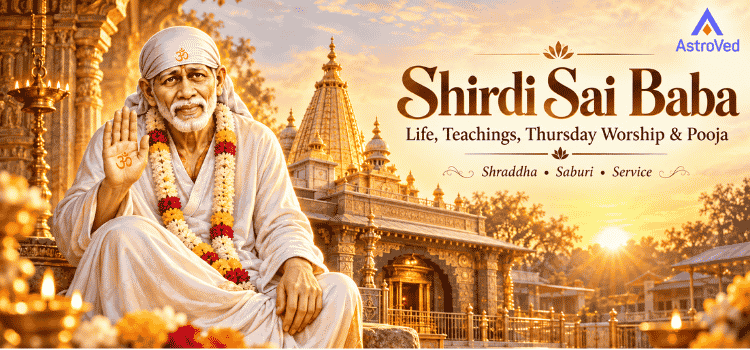
Shirdi Sai Baba: Life, Teachings, Thursday Worship and Pooja
 On September 24, 2026
Overview
Shirdi Sai Baba was a spiritual saint who lived in Shirdi, Maharashtra. He guided people through faith, patience, kindness and service. His exact birthplace, parents and religious background remain uncertain. For this reason, people know his life mainly through his years in Shirdi and his teachings.
Sai Baba brought people of different backgrounds together. He lived simply and treated rich and poor alike. He also encouraged charity and asked devotees to keep faith in God during difficult times. Devotees closely connect Sai Baba with Shraddha and Saburi, meaning faith and patience. They also remember his message of unity. In addition, Dwarkamai, the sacred Dhuni and Udi remain central to Sai devotion.
Thursday is an important day for Sai Baba worship because devotees honor him as a Sadguru. Shirdi also has special Thursday traditions. These include worship at Gurusthan and the Chavadi procession.
This blog covers Sai Baba's life, teachings and Thursday worship in simple detail. It also explains Sai Baba Pooja, Vrat, Om Sai Ram, Sai Satcharitra, Udi, Shirdi temple and simple worship for beginners.
Table of Content
Shirdi Sai Baba: Life, History and Mahasamadhi
Shirdi Sai Baba spent most of his known life in Shirdi, Maharashtra. He first appeared in the village between 1854 and 1857. At that time, people saw him as a young holy man near a neem tree.
Sai Baba disappeared from Shirdi for a period and returned in 1858 with the wedding party of Chandbhai Patil's nephew. After that return, Shirdi became his permanent home.
 Mhalsapati, a devotee of the Khandoba temple in Shirdi, is closely linked with the name "Sai." Tradition says he welcomed the young fakir with the words "Ya Sai." After that, people began calling him Sai Baba.
Sai Baba first stayed near the neem tree at the place now called Gurusthan. Later, he moved to an old mosque. Devotees came to know this place as Dwarkamai, where Sai Baba spent much of his life.
The details of Sai Baba's early life remain uncertain. Historical records do not clearly state his parents, birthplace or religious identity. However, the AstroVed Sai Baba overview explains his simple life and spiritual journey in Shirdi.
Mhalsapati, a devotee of the Khandoba temple in Shirdi, is closely linked with the name "Sai." Tradition says he welcomed the young fakir with the words "Ya Sai." After that, people began calling him Sai Baba.
Sai Baba first stayed near the neem tree at the place now called Gurusthan. Later, he moved to an old mosque. Devotees came to know this place as Dwarkamai, where Sai Baba spent much of his life.
The details of Sai Baba's early life remain uncertain. Historical records do not clearly state his parents, birthplace or religious identity. However, the AstroVed Sai Baba overview explains his simple life and spiritual journey in Shirdi.
Sai Baba's Daily Life in Shirdi
Sai Baba lived a simple and disciplined life in Shirdi. He wore a kafni and kept very few possessions. In addition, he begged for food and shared what he received with people and animals.
Devotees offered Sai Baba Dakshina, or voluntary offerings given with respect. Sai Baba kept very little for himself. He used a small part for needs such as fuel for the Dhuni and gave much of the rest to poor and needy people. He also shared food with devotees and animals. This practice reflected charity, service and freedom from attachment.
For a deeper background, read AstroVed's history of Shirdi Sai Baba.
Sai Baba's Mahasamadhi
Sai Baba attained Mahasamadhi on October 15, 1918, on Vijayadashami. This marked the end of his physical life in Shirdi. However, his teachings continued through his devotees.
Sai Baba's Samadhi is in Butti Wada, which later became the Samadhi Mandir. Today, devotees visit the Samadhi Mandir as the main Sai Baba shrine in Shirdi.
| Important Point |
Traditional / Historical Detail |
| First known appearance in Shirdi |
Around 1854 to 1857, according to the official Shirdi chronology |
| Return to Shirdi |
1858, with Chandbhai Patil's wedding party |
| Main residence |
Dwarkamai |
| Mahasamadhi |
October 15, 1918 |
| Samadhi |
Butti Wada, now Samadhi Mandir |
Teachings of Sai Baba: Shraddha, Saburi and Service
Sai Baba taught through simple words, personal guidance and the example of his own life. He did not depend on long formal lectures. Instead, devotees learned through conversations, stories, daily events and direct experience.
Shraddha and Saburi
Shraddha means faith, while Saburi means patience. These two qualities form one of the clearest summaries of Sai Baba's spiritual guidance.
Shraddha asks a devotee to keep sincere faith in God and the Guru. However, faith does not mean expecting an immediate result. It means continuing spiritual practice with trust.
Saburi asks a devotee to remain patient while life unfolds. Therefore, Sai Baba's teaching joins faith with patience. Devotion can become restless when a person expects instant answers.
Shri Sai Satcharitra presents Shraddha and Saburi as two essential qualities for spiritual life. The text explains this teaching through the story of Radhabai Deshmukh.
Charity, Food Sharing and Compassion
Sai Baba treated charity as part of spiritual life. He gave away much of the Dakshina he received. In addition, he shared food with people and animals.
Service to others reflects Sai Baba's teaching in a practical way. Feeding someone in need, helping without discrimination and speaking kindly can become forms of Sai devotion.
Simplicity and Detachment
Sai Baba lived with very few possessions even as his fame grew. As a result, his simple lifestyle showed that spiritual value does not depend on wealth, social position or display.
Sai Baba taught devotees to perform their duties without letting ego or attachment control them. Therefore, faith, patience and service become meaningful when they shape everyday behavior.
Thursday Worship: Sai Baba Pooja and Vrat
Thursday is an important day for Sai Baba worship because devotees honor him as a Sadguru, or spiritual teacher. Tradition also connects Thursday with Guru worship. In Shirdi, several customs give this day special importance.
Gurusthan gives Thursday a special place in Sai Baba devotion. Devotees traditionally offer prayer and incense there with faith.
The Chavadi procession also has a strong Thursday connection. This tradition grew from Sai Baba's life in Shirdi. Today, it remains an important weekly observance.
Simple Sai Baba Pooja at Home
Sai Baba Pooja at home can remain simple, clean and sincere. A devotee does not need an elaborate ritual to begin worship.
- Prepare the prayer space: Keep an image or idol of Sai Baba in a clean place.
- Light a lamp: Use the lamp as a simple sign of prayer and attention.
- Offer flowers: Choose fresh flowers available to you.
- Offer Naivedyam: Fruits, sweets or simple vegetarian food may be offered according to family practice.
- Chant Sai Baba's name: Repeat Om Sai Ram or another familiar Sai prayer.
- Read a short passage: Read from the Sai Satcharitra or another trusted devotional text.
- Perform Aarti: Devotees may include a familiar Sai Baba Aarti followed in their family or temple tradition.
- Conclude with prayer: Offer gratitude and pray for clarity, patience and strength.
Shirdi follows four main daily Aarti periods. Kakad Aarti is performed in the morning, Madhyan Aarti at midday, Dhoop Aarti around sunset and Shej Aarti at night. At home, beginners can follow a simple Sai Baba Aarti that is familiar to their family or temple tradition.
Om Sai Ram is a devotional chant, not the name of an Aarti. Devotees can chant Om Sai Ram before or after Aarti as part of their personal prayer routine.
The best time for Sai Baba Pooja depends on the devotee's routine and family tradition. Morning and evening are both suitable for home worship. Therefore, devotees can choose a time when they can pray with attention.
Offerings for Sai Baba
Devotees commonly offer flowers, fruits, sweets, simple food, incense and a lamp to Sai Baba. No single flower or food item is compulsory for every devotee.
Devotees may also offer Sai Baba Vastra where temple rules allow clothing offerings. They can choose clean new cloth according to local temple practice. However, no single color is required for all Sai Baba worship.
The value of an offering lies in devotion rather than price or size. For example, a simple flower, fruit or prayer can be meaningful when offered with sincere attention.
Sai Baba Thursday Vrat
Sai Baba Thursday Vrat combines prayer, simple food or fasting, and remembrance of Sai Baba. However, devotees follow different Vrat traditions. Therefore, there is no single format that everyone must follow.
Many devotees observe Sai Baba Vrat for nine Thursdays. However, this is a popular devotional custom, not a rule for every devotee. Sai Baba can also be worshipped on Thursday without fasting. A partial fast can suit devotees who do not wish to keep a complete fast. For example, some take fruits, milk or one simple vegetarian meal. Health and personal capacity should come before strict fasting.
Udyapan means the completion of a Vrat, but its rules can vary. Devotees should follow the same family or worship tradition used when starting the Vrat. In addition, many Vrat traditions include prayer, food sharing and charity.
Thursday worship can also include Sai Baba mantra chanting. AstroVed's Sai Baba mantra guide provides a collection of devotional Sai mantras.
Om Sai Ram, Sai Satcharitra, Udi and Dhuni
Meaning of Om Sai Ram
Om Sai Ram is a simple prayer phrase that devotees use to remember Sai Baba. "Om" is a sacred sound, "Sai" refers to Sai Baba and "Ram" is a Divine name. Together, the words form a simple devotional prayer.
Devotees use Om Sai Ram during prayer, meditation, Japa and daily remembrance. In addition, many devotees use it as a greeting. This keeps Sai Baba's name present in daily life.
There is no universal rule for the number of Om Sai Ram repetitions. For example, a devotee may choose 11, 21 or 108 repetitions. Others may simply repeat the name whenever they wish to remember Sai Baba.
Shri Sai Satcharitra
Shri Sai Satcharitra is one of the main devotional books about Sai Baba's life and teachings. Govind Raghunath Dabholkar, known as Hemadpant, wrote it in Marathi. The book shares stories, teachings and experiences connected with Sai Baba and his devotees.
Sai Satcharitra explains Sai Baba's teachings through real events and devotee experiences. For example, it includes themes such as faith, Guru devotion, Udi, Dakshina, charity and surrender.
Sai Satcharitra Parayan means reading the text in a planned devotional way. Some devotees complete it over a set number of days. Meanwhile, others read one chapter each day.
Beginners do not need to finish Sai Satcharitra quickly. Instead, they can start with one chapter or a few pages. Devotees can also find the text in several Indian languages.
Udi and the Dhuni at Dwarkamai
Udi is the sacred ash connected with the Dhuni at Dwarkamai. Sai Baba gave Udi to devotees. Therefore, Udi remains an important part of Sai Baba devotion.
The Dhuni is the sacred fire at Dwarkamai that Sai Baba kept burning. Historical accounts say he used part of the Dakshina he received to buy fuel for the fire.
Udi also teaches a simple lesson about the temporary nature of material life. Ash reminds devotees that the body and material possessions do not last forever. Therefore, the teaching encourages deeper spiritual thought.
Devotees also regard Udi as sacred Prasad. Claims about physical healing belong to devotional belief and should not replace appropriate medical care.
Shirdi Sai Baba Temple and Sacred Places
Shirdi is the main pilgrimage center connected with Sai Baba's life. Important places include Samadhi Mandir, Dwarkamai, Gurusthan, Chavadi and Lendi Bagh. Together, these places reflect different parts of his life in Shirdi.
AstroVed's Shirdi Sai Baba Temple guide gives an additional overview of the temple and its significance.
| Sacred Place |
Why It Is Important |
| Samadhi Mandir |
Houses Sai Baba's Samadhi and serves as the main Darshan shrine |
| Dwarkamai |
The mosque where Sai Baba lived for much of his life and maintained the Dhuni |
| Gurusthan |
The neem-tree site connected with Sai Baba's early years in Shirdi |
| Chavadi |
The place where Sai Baba stayed on alternate nights during his later years |
| Lendi Bagh |
A garden area that Sai Baba regularly visited |
Samadhi Mandir
Samadhi Mandir is the central shrine of Sai Baba in Shirdi. The building began as Butti Wada. Later, it became the site of Sai Baba's Samadhi.
Dwarkamai
Dwarkamai was Sai Baba's main home in Shirdi. Devotees connect this place with the sacred Dhuni, Udi and many remembered interactions with Sai Baba.
Gurusthan
Gurusthan marks the neem-tree area linked with Sai Baba's early years in Shirdi. The name means "place of the Guru." For this reason, the site is especially meaningful to devotees who honor Sai Baba as a Sadguru.
Chavadi
Chavadi became important because Sai Baba stayed there on alternate nights during his later years. The Thursday Chavadi procession grew from this tradition. As a result, Chavadi remains a major part of Sai devotion in Shirdi.
Sai Baba Temples Beyond Shirdi
Sai Baba worship now extends far beyond Shirdi. Devotees who cannot travel to Maharashtra often visit Sai temples in their own cities. For example, these temples may offer Aarti, Pooja, bhajans and Thursday worship.
For readers in Chennai, AstroVed's guide to the Mylapore Shirdi Sai Baba Temple explains its history, timings and Thursday importance.
Simple Sai Baba Worship for Beginners
A beginner can start Sai Baba worship with a very simple daily routine. The practice does not need to begin with fasting, long prayers or a large Pooja setup.
| Simple Practice |
How to Begin |
| Daily remembrance |
Say Om Sai Ram quietly for a few minutes |
| Simple prayer |
Speak sincerely to Sai Baba about your gratitude, worries or intentions |
| Thursday practice |
Light a lamp, offer a flower or fruit and spend extra time in prayer |
| Sai Satcharitra |
Read one chapter or a few pages regularly |
| Service |
Help someone, feed a person in need or support a charitable act |
Devotees can worship Sai Baba every day, not only on Thursday. However, Thursday can become a special day for longer prayer, temple Darshan, Sai Satcharitra reading or charity.
Fasting is not compulsory for Sai Baba worship. Instead, a devotee can pray, chant Om Sai Ram, read Sai Satcharitra or perform Aarti without observing a Vrat.
Beginners can build the practice slowly. For example, regular prayer, patience and compassionate action can come first. There is no need to follow every custom at once.
Devotees who prefer priest-performed worship can explore AstroVed's Shirdi Sai Baba temple services. These services offer another way to take part in Sai Baba worship when travel is difficult.
Frequently Asked Questions About Shirdi Sai Baba
Who is Shirdi Sai Baba?
Shirdi Sai Baba was a spiritual saint who lived in Shirdi, Maharashtra. He taught faith, patience, kindness and unity. Although his early life remains uncertain, his years in Shirdi are central to his story.
What is special about Shirdi Sai Baba?
Shirdi Sai Baba is especially remembered for Shraddha, Saburi and kindness. He also brought people from different religious backgrounds together. As a result, service, charity and humility became important parts of Sai devotion.
Why is Sai Baba famous?
Sai Baba became widely known as a saint and Sadguru. He guided people without giving importance to caste, wealth or religion. Over time, Shirdi grew into a major pilgrimage center.
Why do people worship Sai Baba?
Devotees worship Sai Baba as a Guru, saint and Divine guide. Sai worship commonly focuses on faith, patience, prayer, protection, compassion and surrender to God.
When did Sai Baba come to Shirdi?
Sai Baba first appeared in Shirdi between 1854 and 1857. He later returned in 1858 with Chandbhai Patil's wedding party. After that, he remained in Shirdi.
How did Sai Baba get the name “Sai”?
Tradition links Mhalsapati with giving Sai Baba the name "Sai." It says he welcomed the young fakir with the words "Ya Sai." After that, people widely used the name Sai Baba.
Was Sai Baba Hindu or Muslim?
Sai Baba's religious identity remains uncertain. His life included practices linked with both Hindu and Muslim traditions. However, his teachings focused on one Divine reality beyond religious division.
When did Sai Baba attain Mahasamadhi?
Sai Baba attained Mahasamadhi on October 15, 1918, on Vijayadashami. His followers placed his body in Butti Wada, which later became Samadhi Mandir.
What are the main teachings of Sai Baba?
Sai Baba's main teachings include Shraddha, Saburi, kindness, charity, humility and service. In addition, he encouraged faith in one Divine power. In daily life, he asked devotees to remain patient and responsible.
What does Shraddha and Saburi mean?
Shraddha means faith and Saburi means patience. Together, they teach devotees to trust the Divine and remain steady. In addition, they encourage patience while life unfolds.
Why is Thursday special for Sai Baba?
Thursday is special because devotees honor Sai Baba as a Sadguru. Tradition also links Thursday with Guru worship. In Shirdi, Gurusthan and the Chavadi procession add to the importance of this day.
What should I offer Sai Baba on Thursday?
Devotees can offer flowers, fruit, sweets, simple vegetarian food, incense, a lamp or clean Vastra. The exact offering can follow family or temple tradition. No single item is compulsory for everyone.
Can I worship Sai Baba without fasting?
Yes, devotees can worship Sai Baba without fasting. They may pray, chant Om Sai Ram, read Sai Satcharitra or perform Aarti. In addition, charity can form part of the observance.
How many Thursdays should I observe Sai Baba Vrat?
Nine Thursdays is a popular Sai Baba Vrat format. However, it is not a universal rule for all devotees. Fasting should also suit the devotee's health and circumstances.
What does Om Sai Ram mean?
Om Sai Ram is a devotional prayer used to remember and honor Sai Baba. Devotees use it during Japa, prayer and meditation. In addition, many use it as a spiritual greeting.
How many times should I chant Om Sai Ram?
There is no compulsory count for Om Sai Ram chanting. For example, devotees may choose 11, 21 or 108 repetitions. They may also repeat the chant whenever they wish.
What is Sai Satcharitra?
Shri Sai Satcharitra is a devotional text about Sai Baba's life, teachings and experiences with devotees. Hemadpant, the pen name of Govind Raghunath Dabholkar, wrote the work in Marathi.
What is Sai Baba Udi?
Udi is the sacred ash connected with the Dhuni at Dwarkamai. Sai Baba gave Udi to devotees. In addition, Udi reminds devotees that material life is temporary.
What places should I visit in Shirdi?
The main Sai Baba places in Shirdi include Samadhi Mandir, Dwarkamai, Gurusthan, Chavadi and Lendi Bagh. Each place connects with a different part of Sai Baba's life and devotional tradition.
Conclusion
Shirdi Sai Baba's life brings together faith, patience, service and simplicity. In addition, his years in Shirdi gave spiritual importance to Dwarkamai, Gurusthan, Chavadi and Samadhi Mandir.
Sai Baba worship can remain simple. For example, a devotee may begin with Om Sai Ram, a lamp or a short prayer. Later, Sai Satcharitra reading and acts of service can be added gradually.
The heart of Sai Baba's teaching remains Shraddha and Saburi. Faith gives direction, while patience helps a devotee continue that path with steadiness.- sai baba
- Sai baba pooja
- sai baba temple
- shridi sai baba
- Shridi temple


 The item has been added to your cart.


