Introduction
Many people who are new to Vedic astrology often wonder whether they should read predictions based on their Ascendant or their Moon sign. The truth is that both are equally important, but they represent different aspects of life. Understanding the distinction between them helps you interpret your horoscope correctly and gain deeper insight into your personality, emotions, and future. Professional astrologers never rely on just one factor. Instead, they analyze both the Ascendant and the Moon sign together to provide accurate predictions.
What Is the Ascendant?
The Ascendant, also called the
Lagna, is the zodiac sign rising on the eastern horizon at the exact moment of your birth. Since it changes approximately every two hours, an accurate birth time is essential for calculating it correctly.
The Ascendant represents your physical appearance, personality, health, confidence, attitude, and the way you interact with the world. It also forms the foundation of the birth chart because all twelve houses are determined from the Ascendant. Every major life event, including career, education, marriage, finances, and health, is studied primarily from this point.
What Is the Moon Sign?
The Moon sign is the zodiac sign occupied by the Moon at the time of birth. Unlike the Ascendant, it changes approximately every two and a half days, making it less dependent on the exact birth time.
The Moon governs the mind, emotions, thoughts, feelings, imagination, and mental stability. It explains how you react emotionally to different situations and how you process life's experiences. Since the Moon reflects your inner nature, it plays a significant role in understanding your emotional well-being and personal relationships.
Why Is the Ascendant Important?
The Ascendant provides a complete framework for interpreting a horoscope. Astrologers use it to study important areas such as career growth, professional success, financial stability, marriage, children, health, property, and overall life direction. Because the twelve houses are calculated from the Ascendant, it serves as the primary reference point for detailed horoscope analysis.
Why Is the Moon Sign Important?
The Moon sign is especially valuable for understanding emotional health and the impact of planetary transits. Many daily, weekly, monthly, and yearly horoscope predictions are written based on the Moon sign because it reflects how a person experiences the results of planetary movements. It is also important for evaluating emotional compatibility, peace of mind, and mental resilience.
Ascendant vs Moon Sign
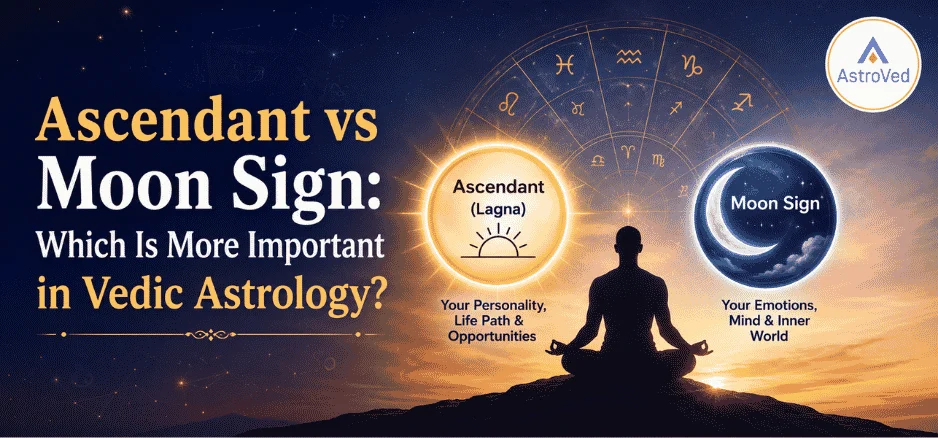
The Ascendant describes your external personality and the opportunities available in your life, while the Moon sign reflects your inner emotional world. For example, a person may appear confident, courageous, and independent because of a strong Ascendant, yet internally feel sensitive, anxious, or emotional due to the influence of the Moon sign. This is why relying on only one factor can provide an incomplete understanding of a horoscope.
Which One Should You Follow?
If you are reading general horoscope forecasts or transit predictions, the Moon sign is often useful because it reflects your emotional response to planetary movements. However, if you are seeking detailed guidance regarding career, marriage, finances, education, business, or health, the Ascendant should always be given greater importance. Experienced astrologers examine both together before reaching any conclusion.
Conclusion
There is no competition between the
Ascendant and the Moon sign. Each serves a unique purpose in Vedic astrology. The Ascendant reveals your life's direction, physical personality, and practical experiences, while the Moon sign explains your emotions, thoughts, and mental outlook. When both are studied together, they provide a balanced and comprehensive understanding of your horoscope. By considering both, you can make better decisions, understand your strengths and challenges, and use astrology as a practical guide for personal growth and future planning.


 The item has been added to your cart.
 On July 14, 2026


