AI and Horoscope Patterns: Discover Hidden Insights
 On June 05, 2026
AI and Horoscope Patterns: Discover Hidden Insights
Have you ever wondered whether there is more to your horoscope than what appears on the surface? Most people read their daily zodiac forecast and quickly move on. However, artificial intelligence can help examine astrological information in greater detail and highlight patterns that may otherwise be difficult to notice.
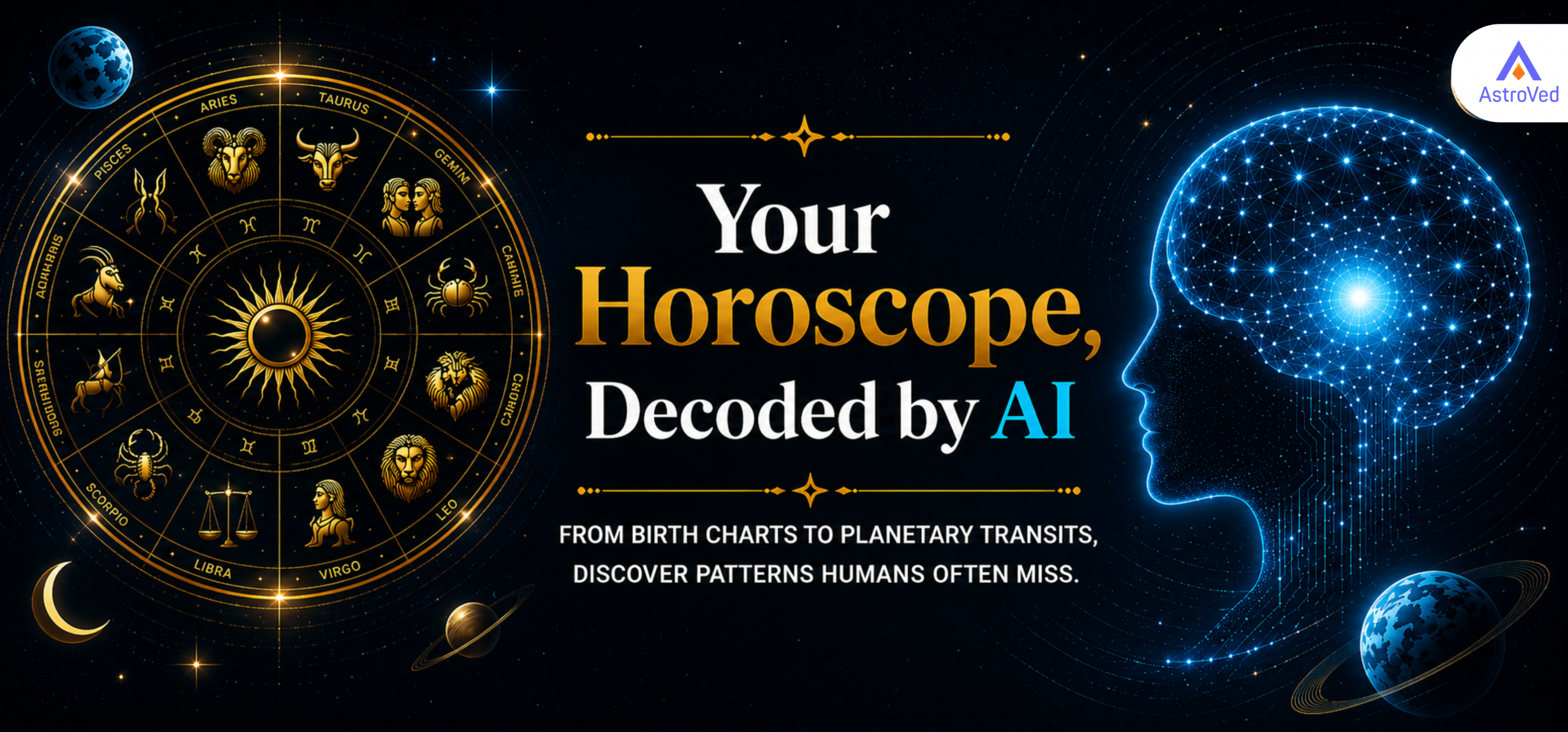 The intersection of AI and astrology is no longer just an idea. Today, advanced computational systems can analyze horoscope readings, birth chart details, planetary movements, and recurring astrological combinations. As a result, these tools may help astrologers identify connections that are difficult to examine manually.
At AstroVed, technology can support traditional astrological interpretation by organizing complex chart information and helping provide more personalized insights.
The intersection of AI and astrology is no longer just an idea. Today, advanced computational systems can analyze horoscope readings, birth chart details, planetary movements, and recurring astrological combinations. As a result, these tools may help astrologers identify connections that are difficult to examine manually.
At AstroVed, technology can support traditional astrological interpretation by organizing complex chart information and helping provide more personalized insights.
Quick Answer
AI can help identify hidden horoscope patterns by processing large amounts of birth chart data, planetary transits, and astrological combinations. By comparing recurring patterns, these systems can assist astrologers in recognizing possible connections between celestial movements and different areas of life.
However, AI should be viewed as a supporting tool rather than a replacement for professional astrological interpretation.
How AI Analyzes Horoscope Data
A birth chart is highly personal because it is calculated using an individual’s birth date, birth time, and birth location. While traditional astrology follows established principles and time-tested interpretations, AI can help organize and compare large amounts of chart information more efficiently.
Machine learning systems can process numerous data points, including:
- Planetary positions
- House placements
- Aspect relationships
- Nakshatras
- Dashas
- Current planetary transits
Because these systems can review many combinations at once, they may highlight subtle patterns within complex astrological data.
Traditional horoscope interpretation often begins with general planetary principles. In contrast, AI-assisted analysis can compare specific chart placements and identify recurring themes connected with career, relationships, finances, or personal development.
Therefore, technology can make detailed chart interpretation more accessible without removing the importance of traditional astrological knowledge.
Identifying Cosmic Cycles and Recurring Patterns
One of the most useful applications of AI in astrology is pattern-based timing analysis. Traditional astrology may explain that a planet is transiting a particular sign. However, AI-supported tools can help examine how that transit interacts with an individual’s birth chart.
For example, the system may consider:
- Birth time and location
- Natal planetary placements
- Current transits
- Dasha and Bhukti periods
- Previous recurring chart patterns
By comparing these details, AI can help identify periods when certain life themes may become more active.
For instance, some planetary combinations may repeatedly appear during career changes, relationship developments, financial decisions, or periods of introspection. Although these patterns should not be treated as guaranteed predictions, they can offer useful guidance.
In this way, AI contributes to astrology through structured pattern recognition rather than simple fortune-telling.
The Role of Machine Learning in Birth Chart Interpretation
A Vedic birth chart includes 12 houses, nine Grahas, zodiac signs, Nakshatras, aspects, Dashas, and numerous planetary combinations. Manually examining every possible relationship between these factors can require significant time and expertise.
Machine learning can simplify this process by organizing the information and identifying potentially meaningful combinations.
During AI-assisted horoscope analysis, the system may consider:
- Your Sun, Moon, and Ascendant
- Planetary placements in all 12 houses
- Harmonious and challenging planetary aspects
- Current transits and planetary periods
- Nakshatra placements
- Important Yogas and Doshas
- Areas of life connected with your question
For example, if your concern relates to your career, the analysis may give greater attention to the 10th house, its ruler, and current planetary influences. Similarly, relationship questions may require closer examination of the 7th house, Venus, Jupiter, and relevant Dashas.
Therefore, AI helps connect the different parts of the chart while an astrologer interprets their significance within the individual’s life.
Personalized Predictions Versus Generic Horoscopes
Generic daily horoscopes usually provide broad predictions based primarily on one zodiac sign. As a result, the same forecast may be read by millions of people who have very different birth charts and life circumstances.
However, personalized horoscope analysis considers a much wider range of information.
An AI-assisted personal reading may include:
- Exact birth time
- Birth location
- Ascendant
- Moon sign
- Nakshatra
- Planetary positions
- House rulers
- Current transits
- Dasha periods
Because of this detailed approach, personalized readings are generally more relevant than broad Sun sign forecasts.
At AstroVed, AI technology can support professional astrologers by helping process complicated chart information. Consequently, the astrologer can focus more closely on interpretation, context, and practical guidance.
Rather than receiving a general prediction, individuals can explore insights based on their unique astrological profile.
How AI Can Reveal Hidden Horoscope Patterns
Some astrological patterns are easy to identify, while others involve several planets, houses, and timing systems. AI can support astrologers by reviewing these complex combinations more quickly.
Timing Patterns
Repeated planetary combinations may appear during important life events. Therefore, AI can help compare current planetary influences with similar past periods in the chart.
Planetary Relationships
Several planets may influence the same house or life area. By analyzing these relationships together, AI may help identify themes that are not obvious when each placement is examined separately.
Dasha and Transit Connections
A transit may produce different results depending on the active Dasha period. Consequently, an AI-supported system can compare both factors before presenting possible interpretations.
Nakshatra Patterns
Nakshatras add another layer of detail to Vedic astrology. AI can help organize Nakshatra rulers, Pada placements, and planetary relationships to support more refined analysis.
Recurring Life Themes
Some individuals repeatedly experience similar patterns in relationships, work, or finances. Through chart comparison, AI may help identify the astrological combinations associated with those recurring themes.
Real-World Applications of AI Horoscope Analysis
AI-assisted horoscope analysis may be useful across several areas of life. However, the results should be understood as guidance rather than guaranteed outcomes.
Career Timing
AI can help examine the 10th house, its ruler, Jupiter, Saturn, Mercury, the active Dasha, and current planetary transits.
As a result, the analysis may identify periods that appear more supportive for:
- Changing jobs
- Starting a business
- Requesting a promotion
- Taking on leadership responsibilities
- Learning new professional skills
A generic horoscope may simply suggest that career growth is possible. In comparison, personalized analysis can explain which planetary factors are influencing your professional life.
Relationship Patterns
Relationship analysis may include the 7th house, Venus, Jupiter, Mars, the Moon, and relevant Dasha periods.
Therefore, AI-supported astrology can help examine:
- Emotional compatibility
- Relationship timing
- Communication patterns
- Periods of closeness or distance
- Repeated relationship challenges
These insights can help individuals understand their emotional patterns more clearly.
Financial Trends
Financial astrology often involves the 2nd, 5th, 8th, 9th, and 11th houses. In addition, Jupiter, Venus, Mercury, and current planetary periods may influence financial conditions.
AI can help organize these factors and identify periods that may require greater planning or caution.
However, astrological guidance should not replace professional financial advice.
Education and Learning
Mercury, Jupiter, the 4th house, and the 5th house are important for learning and education.
By analyzing these factors together, AI may help highlight:
- Favorable learning periods
- Areas of natural intellectual strength
- Possible concentration challenges
- Suitable fields of study
Spiritual Growth
Vedic astrology also examines spiritual development through Ketu, Jupiter, the 5th, 8th, 9th, and 12th houses, as well as specific Dashas.
Consequently, AI-assisted analysis may help identify periods that support meditation, spiritual learning, or deeper self-reflection.
The Advantages of AI-Assisted Astrology
AI can offer several practical advantages when used responsibly.
Faster Data Processing
Birth charts contain many interconnected factors. AI can process and organize this information quickly, which allows astrologers to spend more time interpreting its meaning.
Greater Personalization
Instead of relying only on one zodiac sign, AI can consider the complete chart. Therefore, the reading can be more closely aligned with the individual’s astrological profile.
Consistent Calculations
Accurate astrology requires precise planetary calculations. Computational tools help reduce calculation errors and maintain consistency.
Identification of Complex Patterns
Some chart combinations involve several planets, houses, and timing systems. AI may help reveal these complex relationships more efficiently.
Support for Astrologers
Most importantly, AI can support astrologers rather than replace them. Technology handles data organization, while astrologers contribute experience, intuition, spiritual understanding, and personal context.
The Limitations of AI Horoscope Analysis
Although AI can process astrological data efficiently, it also has limitations.
First, AI does not understand human life in the same way an experienced astrologer does. Personal circumstances, emotional experiences, cultural background, and individual choices require human understanding.
Moreover, astrological interpretation is not based only on calculation. It also involves judgment, context, and a careful understanding of how several chart factors interact.
Therefore, AI-generated interpretations should be reviewed thoughtfully. They should not be treated as absolute predictions or used as the sole basis for major medical, legal, financial, or personal decisions.
The strongest approach combines technology with professional astrological guidance.
AI and Vedic Astrology
Vedic astrology is especially suitable for computational support because it involves detailed calculations and layered timing systems.
For example, Vedic analysis may include:
- Rasi chart
- Navamsa and divisional charts
- Nakshatras and Padas
- Vimshottari Dasha
- Planetary transits
- Yogas
- Doshas
- Ashtakavarga
- House strengths
Because of this complexity, AI can help calculate, organize, and compare information efficiently.
Nevertheless, the final interpretation still requires knowledge of Vedic principles. Therefore, technology is most effective when combined with the expertise of a qualified astrologer.
How AstroVed Combines Astrology and AI
AstroVed can combine traditional Vedic astrology with modern technology to support personalized horoscope analysis.
The process may include:
- Collecting accurate birth details
- Calculating the individual birth chart
- Analyzing planetary placements and timing periods
- Identifying important horoscope patterns
- Reviewing the results through astrological principles
- Providing personalized guidance and remedies
Through this combined approach, technology supports efficiency while astrologers contribute insight and context.
As a result, individuals can receive guidance that is more detailed than a general zodiac forecast.
Key Takeaways
- AI can process large amounts of horoscope and birth chart information
- Personalized readings consider more factors than generic zodiac predictions
- Pattern analysis can help identify recurring astrological themes
- AI may support timing analysis through Dashas and transits
- Vedic astrology is well suited to computational analysis
- AI should assist professional astrologers rather than replace them
- Astrological insights should be treated as guidance, not guaranteed outcomes
Frequently Asked Questions
Can AI predict the future from a horoscope?
AI cannot guarantee future events. However, it can help identify possible timing patterns and recurring astrological themes based on planetary placements, transits, and Dashas.
Therefore, AI horoscope analysis should be viewed as guidance rather than certain prediction.
What is the difference between AI horoscopes and regular zodiac predictions?
Regular zodiac forecasts are usually based on one sign and provide broad interpretations. In contrast, AI-assisted horoscope analysis can examine the complete birth chart, including the Ascendant, Moon sign, planets, houses, Nakshatras, transits, and Dashas.
As a result, personalized analysis may offer more relevant insights.
How does machine learning identify hidden patterns in astrology?
Machine learning processes large amounts of structured information and looks for recurring relationships between different data points.
In astrology, this may involve comparing planetary positions, house placements, aspects, Dashas, and transits. However, an astrologer should interpret these patterns within the individual’s life context.
Is Vedic astrology compatible with AI analysis?
Yes. Vedic astrology involves many calculations, including Dashas, Nakshatras, Vargas, Yogas, and planetary strengths.
Therefore, AI and computational systems can help organize and analyze this information efficiently.
Can I receive an AI-powered personalized astrology reading?
AstroVed can use AI-supported tools alongside professional astrology expertise to provide personalized insights based on birth chart details.
For accurate analysis, you will usually need to provide your birth date, birth time, and birth location.
Does AI replace professional astrologers?
No. AI can process data and identify patterns, but it does not replace an astrologer’s experience, intuition, interpretation, or understanding of personal circumstances.
Instead, the most effective approach combines computational analysis with human guidance.
What birth information is required for AI horoscope analysis?
Accurate analysis generally requires:
- Date of birth
- Exact time of birth
- Place of birth
Precise birth time is especially important because it affects the Ascendant and house placements.
Conclusion: Your Horoscope Enhanced by Technology
The patterns within a horoscope have always been present. What has changed is the ability to examine complex astrological data more efficiently.
AI does not replace astrology. Instead, it can support calculations, organize information, and highlight connections that deserve closer attention. Meanwhile, professional astrologers provide the interpretation, context, and spiritual understanding necessary to make the insights meaningful.
Therefore, the future of horoscope analysis does not require choosing between tradition and technology. A balanced approach can combine the wisdom of Vedic astrology with modern computational tools.
At AstroVed, AI-assisted astrology can help provide more detailed and personalized insights into your birth chart. Rather than relying only on generic zodiac forecasts, you can explore the unique patterns connected with your career, relationships, finances, and spiritual growth.
Discover what personalized horoscope pattern analysis may reveal about your cosmic blueprint.- Ai Vedic Astrology
- Astrological Birth Chart
- astrology by date of birth


 The item has been added to your cart.


