Home → Blog → News → Ardhanarishvara The combined form of Shiva and Shakti
Ardhanarishvara The combined form of Shiva and Shakti
On June 10, 2022
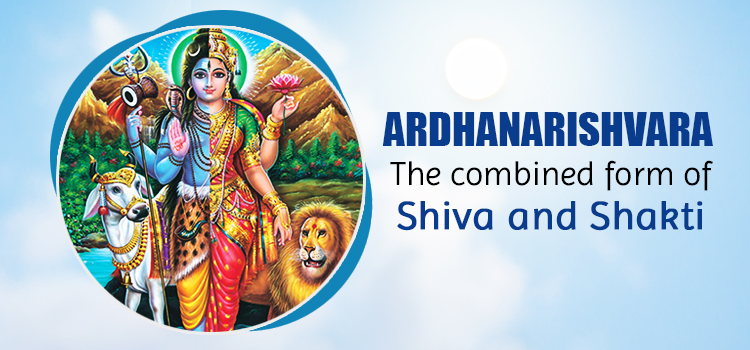
Ardhanarishvara is a form of Lord Shiva where he merges with Goddess Parvati so that one half is male and the other half is female. ‘Ardha’ means ‘half’, ‘nari’ means ‘woman’, and ‘ishvara’ means ‘lord’. The right half of this androgynous form represents Shiva, and the left half represents Parvati. Ardhanarishwara depicts a perfect balance of male and female as equals. The male half stands for “Purusha,” and the female half stands for “Prakriti.” These are the masculine and feminine energies of the cosmos, respectively, and also the male principle of God (Shiva) and the female principle (Shakti).
There are many legends about how Ardhanarishvara came into being. The Shiva Purana says that Lord Brahma created several males during the process of creation. They were the Prajapatis. Brahma ordered them to create other beings, but they were unable to. Worried, Brahma meditated on Lord Shiva, who appeared before him as Ardhanariswara, the composite form of male and female. Then Brahma realized where he had erred and created females. Creation supposedly gathered momentum after this.
There is a related myth in the Skanda Purana. Here, Brahma asked Rudra to divide himself. Rudra divided himself into 2 halves (one was male and the other, female). The Skanda Purana, in another place, also describes Parvati telling Shiva that she wanted to reside in him, embracing him limb by limb. Thus, she merges into Shiva, and the duality is eliminated.
Other names for Ardhanarishvara are Ardhanarisha, Ardhagureeshwara, Ardhayuvateeshwara, Gaureeshwara, Parangada, Naranari, and Ammiappan.
Origin stories of Ardhanarishvara
According to the Shiva Purana, the story of Ardhanarishvara began after Lord Brahma had completed the creation of the world. But after the act of creation, Brahma noticed that things remained the same and that there was no further development. The number of animals, birds, humans, and insects that he created was the same. They were not increasing. The reason? He had created only male forms. Seeing this, Brahma felt worried
Then, Lord Vishnu told him to do penance to Lord Shiva. Shiva was pleased with Brahma’s penance and told him to create the Maithuni creation. Brahma asked Shiva to explain the meaning of the Maithuni creation.
Shiva then appeared as Ardhanarishvara, where half of his body was in a feminine form. But in this form, the male and female parts were separated. Brahma then asked the female half to give him a female so that the world could grow further. The Goddess agreed and created a female using the powers from her body.
Once, a demon called Andhaka fell in love with Goddess Parvati and wanted to make her his wife. But Lord Vishnu rescued her and took her to his abode. The demon followed her, and at this point, Parvati revealed her Ardhanarishvara form to him. When he saw the half-male and half-female form, the demon lost his desire for her and left. Seeing this form of the Goddess, Vishnu was amazed and saw himself in the female part of the form.
In Tamil temple mythology, the story goes that the gods and sages (rishis) had gathered at Mount Kailasa to pay their respects to Shiva and Parvati. However, Sage Bhringi decided to worship only Shiva and ignored Parvati. The angry Parvati cursed the sage to lose all his flesh and blood, and he turned into a skeleton. He could not even stand upright. The compassionate gods and sages who witnessed this scene blessed Bhringi with a third leg for support. Disappointed that her attempt to humiliate Bhringi had failed, Parvati punished herself by doing austerities that pleased Shiva. He also granted her the boon of uniting with him so that Bhringi would have to worship her, too, when they formed Ardhanarishvara. But Bhringi took the form of a beetle and walked around only the Shiva half by drilling a hole in the deity. Parvati was amazed by his devotion, and she blessed him.
Symbolism of Ardhanarishvara
Ardhanarishvara symbolizes the balance between the male and female energies in the cosmos. These two forces are inseparable and complementary. Only if they work together, will there be equilibrium.
Purusha and Prakriti are opposite in nature. While Purusha represents the passive force of the universe, Prakriti is active. Purusha also represents potential energy, while Prakriti is kinetic energy. Purusha is infinite, but Prakriti brings that infinity to be finite. In this manner, they enable one another to generate and sustain the universe.
The union of Shiva’s Linga and the Devi’s Yoni leads to the birth of the entire cosmos. So, this concept also introduces the idea of Lust leading to procreation.Shiva on the left also represents the spiritual sphere, while Shakti represents the material sphere. This indicates that both are needed to bring ecstasy to life.
Many cultures also harbor the belief that Ardhanarishwara symbolizes limitless growth and fertility because Parvati with Shiva has an association with the fecundity of Mother Nature. The Shakti half generally denotes relative inferiority and feminine traits like creativity, intuition, etc. The Shiva half denotes comparative superiority and masculine traits like strength, logic, systematic thoughts, etc.
The Ardhanarishvara concept is often compared with the Chinese concept of Yin and Yang. These are complementary opposites too. While Yin is the gentle and feminine half, Yang is the strong, ferocious, and masculine half.
Lord Ardhanarishvara is worshipped by devotees for wish-fulfillment and spiritual uplift. Ardhanarishvara Pooja and Ardhanarishvara Homam are performed to get the blessings of Shiva and Parvati.
Ardhanarishvara Mantra
Karpur Gauram Karunavataram, Sansara Saram Bhujagendra Haram Sada Vasantam Hridayaravinde Bhavam Bhavani Sahitam Namami.
Ardhnarishwar Pooja/Homa Benefits:
Removes past sins and bad karmas
Spiritual upliftment and wish-fulfillment
For peace and harmony between spouses
For the blessings of Shiva and Shakti
Conclusion
Ardhanariswara illustrates the fact that the matching of opposites creates the rhythm of life. Shiva is nothing without Shakti, and Shakti is powerless without Shiva. If Shakti creates, Shiva is the source of that creation.


 The item has been added to your cart.
 On June 10, 2022
 There is a related myth in the Skanda Purana. Here, Brahma asked Rudra to divide himself. Rudra divided himself into 2 halves (one was male and the other, female). The Skanda Purana, in another place, also describes Parvati telling Shiva that she wanted to reside in him, embracing him limb by limb. Thus, she merges into Shiva, and the duality is eliminated.
Other names for Ardhanarishvara are Ardhanarisha, Ardhagureeshwara, Ardhayuvateeshwara, Gaureeshwara, Parangada, Naranari, and Ammiappan.
There is a related myth in the Skanda Purana. Here, Brahma asked Rudra to divide himself. Rudra divided himself into 2 halves (one was male and the other, female). The Skanda Purana, in another place, also describes Parvati telling Shiva that she wanted to reside in him, embracing him limb by limb. Thus, she merges into Shiva, and the duality is eliminated.
Other names for Ardhanarishvara are Ardhanarisha, Ardhagureeshwara, Ardhayuvateeshwara, Gaureeshwara, Parangada, Naranari, and Ammiappan.


