 The item has been added to your cart.
Click the 'Play' button to read out loud this webpage content
The Vedagiriswarar Temple lies in Thirukazhukundram, 70 kilometers away from Chennai and 15 kilometers away from the shore town of Old Mahabalipuram. The temple is also popularly called the Kazhugu (eagle) temple. There are two temples, one at the foothills and one at the top. The latter has the presiding deity of Shiva, called Vedagiriswarar. The temple at the foothills houses the shrine of his consort, Parvati, also known as Thripurasundarai Amman. Vedagiriswarar denotes the Lord of the Vedic Mountains. The four Nayanmars - Appar, Sundarar, Manickavasagar, and Thirugnanasamandhar, visited the temple and composed hymns in praise of Vedagiriswarar.
Thirukazhukundram derives the name from Tamil words- Thiru (respect), Kazhugu (eagle), and Kundram (mount). The name Thirukazhugukundram later became Thirukazhukundram.
For centuries, this temple was famous for a pair of birds, Egyptian vultures, which came daily at noon to accept Prasadam (offering) from the temple priest. No one was aware whence these birds came from, but they continued for centuries to follow this tradition.
The Egyptian vultures have been visiting the town for centuries. People called the municipality Pakshi Theertham (bird’s holy lake), ever since. The temple priests traditionally fed the vultures, and before noon they were fed offerings made of rice, wheat, sugar, and ghee. When the vultures failed to appear one day, the priests attributed it to sinners in the crowd.
According to legend, there were Ashtavasus (eight sages), who were being punished by Shiva. Angered by the Rishis, Shiva cursed them to live as birds until they had performed penance. Shiva ordered them to visit his temple for prayers and receive the offering from the temple priests. The birds did this for three Yugas (epochs). Six birds attained Mukti (emancipation) while the remaining two survive in the current era. These vultures were two of the sages, and they quit going to the sanctuary and went to the Kali Yuga.
Another legend has it that the two Egyptian Vultures were Sage Poosha and Sage Vidhadha. Earlier, both the sages prayed intensely for long, asking Shiva to grant them the elevated Sharoopa status. Shiva was willing to grant them only the Sayujya status, adding that he would give them the Sharoopa status later, only if he considered them worthy of it. Instead of accepting the Sayujya position, both sages argued with Shiva, demanding that he bestow them with the status immediately. Shiva became angry and cursed the two Rishis, stating they would remain Eagle Vultures till the end of the Kali Yuga. The birds followed Shiva’s diktat and visited the temple for centuries, taking the Prasadam (offering).
In the Kali Yuga, the birds are called Pusha and Vidhadha. It is said they bathed in Rameshwaram, ate in Thirukazhukundram, and spent the rest of the day in Kasi. In 1998, they stopped showing up at the temple, on account of too many sinners present in the crowds. It could also be that the two Ashtavasus had at last gained Moksha (salvation).
Legend has it that Sage Bharadwaja prayed to Shiva for long life so that he could master the Vedas. Shiva appeared before him and created three mountains representing three of the Vedas- Rig, Yajur, and Sama. Shiva said learning could not be achieved in a lifetime and was not the route to Salvation. However, Bhakti (devotion), unconditional and sincere service, and love of God was the only way to attain salvation. The temple sits atop the tallest of the Vedic hills. Hence, the name Vedagiri or the Mountain of the Veda.
Indra, King of the Gods, still worships in this temple. His thunder enters through the roof of the tower and goes around the Shivalinga.
The kings of the Pallava dynasty built the Vedagiriswarar temple. The temple reflects the best of ancient Dravidian architecture. The two temples lie at the foothills and the upper hill. A devotee climbs 565 steps to reach the higher temple.
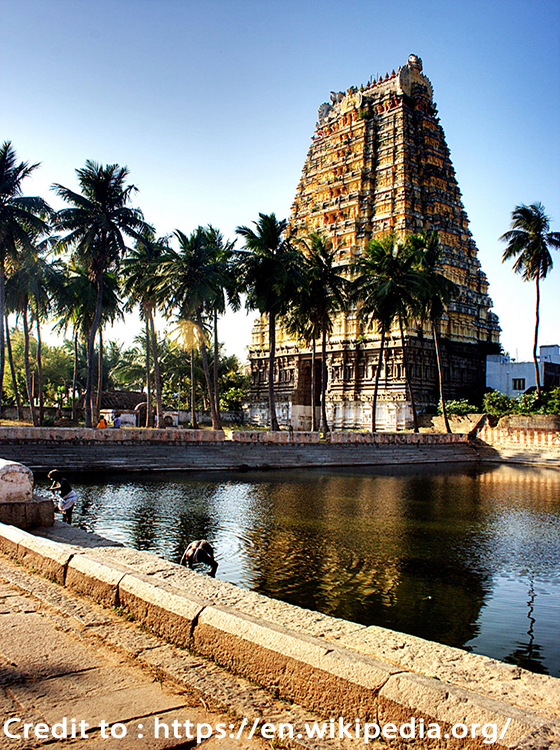
The temple architecture is exquisite with four gopurams, curved Mandapams, and a high compound wall. There is a large water tank called Sangu Teertham, almost akin to a lake. Once in twelve years, a Sangu (conch) emerges from the depths, rises, and floats on the water surface. The priests have collected these conches and kept them in public view.
The temple celebrates the Chithirai festival in April-May, drawing huge crowds, the Aadi Pooram festival for Mother Ambica in July-August, the Full Moon days, New moon days as well as Pradosham, Tamil New Year’s Day, Deepavali and Pongal. Devotees celebrate Girivalam on Full Moon days, and the practice was in place even before it began in Thiruvannamalai. The priests conduct Special Abishekam (sacred wash) and Aradhanas (prayers) on these days.
The temple celebrates a great festival called the Pushpakara Mela, as renowned as the Kumbh Mela celebrated in the North, once in twelve years, and light one lakh Deepams (lamp) during the transition period of planet Jupiter.
The temple tank called the Sangu Teertham contains mineral water and herbal properties. Not only do the priests draw this water for the Abishekams (sacred wash), but devotees also drink this water. It is believed that a person with mental challenges can take a dip in this water and become cured.
Many of the devotees visit the temple for mental peace and salvation. Those who are retarded stay for 48 hours, bathe in the Sangu Theertham, and are fully cured. Any disease, be it blood pressure, asthma, or heart issues, are cured by Vedagiriswarar. Devotees visit the temple seeking boons for marriage and child. Devotees perform Abishekam and Aradhana for the deity. They also conduct Annadhanam(feeding ) and contribute to the temple fund.
The nearest railway station is at Chengalpattu.
There are many state buses and private buses to take people to the temple.
| S No | Temple Pooja Timing | Timings |
|---|---|---|
| 1 | Morning | Temple opens from 6.00 A.M. to 11.00 A.M. |
| 2 | Evening | 4.00 P.M. to 8.30 P.M. |
If you wish to have customized spiritual tours or pilgrimages arranged in India for yourself or for a group of people, please contact Brindavan Mystic Services
Email ID: [email protected]
Toll free: 1800 102 9098
