 The item has been added to your cart.
Click the 'Play' button to read out loud this webpage content
Porur Ramanatheeswarar Temple is in Porur, Chennai. People who could not visit the Rameshwaram Temple can visit this Uttara Rameshwaram. The main deity, Ramanatheeswarar, is revered as Guru Bhagwan. It is a Guru Sthalam. Like Vishnu temples, devotees receive Sadari and Theertham here. In the Pallikondeswara Temple, Surutappalli, Sadari, and Theertham are also offered.
According to legend, Lord Rama rested here on his way to Sri Lanka to rescue Sita. While resting under a Nelli (Amla) tree, his feet unintentionally touched the head of the Shiva Lingam under the ground.
As Rama's feet touched the Lingam, he had a Dosha. So, he performed a penance towards Shiva for forty-eight days by eating only one Amla fruit as his food to recover from the Dosha and bring out the Shiva Lingam.
Rama's penance pleased Shiva, so he came out from the earth and appeared before Rama along with his consort. As Shiva's mercy overwhelmed Rama, he named the Shiva Lingam Ramanatheeswarar and worshipped him.
Rama sincerely worshipped Shiva as his Guru and received directions to the place where Sita was imprisoned. As Rama worshipped Shiva as his Guru, this place became a Guru Sthalam. Here, Shiva himself is worshipped as Guru Bhagwan. This Porur Ramanatheeswarar Temple is associated with the Ramayana period.
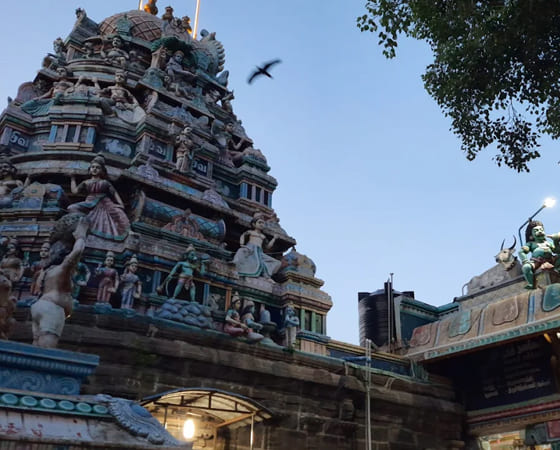
Kulothunga Cholan II built the Porur Ramanatheeswarar Temple in 700 AD. It features the Chola temple architectural style. The temple has a 5-tiered Rajagopuram with one Prakaram. The sanctum is in Gajaprishta shape or Thoongaanai Maadam type. The entrance of the sanctum has Dwarpalakas on either side. The main deity is Ramanatheeswarar, an incarnation of Shiva, facing the east. He graces the sanctum in the form of Swayambu Lingam, which is 6 feet high. A trident is in the sanctum before the deity. Sivakama Sundari is the divine consort. She is enshrined separately in a standing posture with four hands.
The Koshta idols around the sanctum are Vinayagar, Dakshinamurti, Brahma, Vishnu, and Durga. The Bali Peetam and Nandi idols are before the sanctum within the Maha Mandapam. The ceiling of the Maha Mandapam has stucco images of twelve zodiacs.
Stucco images of Kedharnath, Mallikarjun, Beema Sankara Poornar, Triambakeswarar, Vedhanath Poorvi, Kashi Viswanathar, Rameswarar, Kailangiri Nathar, Nageswarar, Somnath, Gukeswarar, Omkareswarar, Yamuleswarar, Mahakaleshwarar and Dasavatar are in the Maha Mandapam.
Though it is a Guru Sthalam, there is no separate shrine for Guru Bhagwan. Navagrahas are with their consorts, which is rare. Kaala Bhairavar, Santana Vijaya Ganapati, Saneeshwaran, and Subramanya-Valli-Devasena have shrines. Chandikeswarar faces south. There is no Dhwajasthambam.
The Nelli Tree (Amla) is the Sthala Vriksham of the Porur Ramanatheeswarar Temple. A Neem tree is on the south side of the Prakaram. Brahma is under the Neem tree, facing north. The temple underwent its latest renovation in 2008.
Maha Shivaratri, Navaratri, Panguni Uthiram, Karthikai Somavaram (Monday), Pournami, Pradosham, and Guru Peyarchi are the main festivals in the Porur Ramanatheeswarar Temple. It conducts the Annual Brahmotsavam every May, which attracts a large crowd.
Devotees visit the Porur Ramanatheeswarar Temple and perform Dosha Nivarthi Pooja to Guru Bhagwan to remove his malefic effects. People also donate yellow clothes, yellow flowers, turmeric, and bananas to Brahmins.
Porur EB Office bus stand is 500 meters away.
Guindy Railway Station is at an 8 Km distance.
Chennai International Airport is the nearest, at 12 Km.
The Porur Ramanatheeswarar Temple remains open daily from 6.00 am to 11.30 am and from 5.00 pm to 8.30 pm.
If you wish to have customized spiritual tours or pilgrimages arranged in India for yourself or for a group of people, please contact Brindavan Mystic Services
Email ID: [email protected]
Toll free: 1800 102 9098
