 The item has been added to your cart.
Click the 'Play' button to read out loud this webpage content
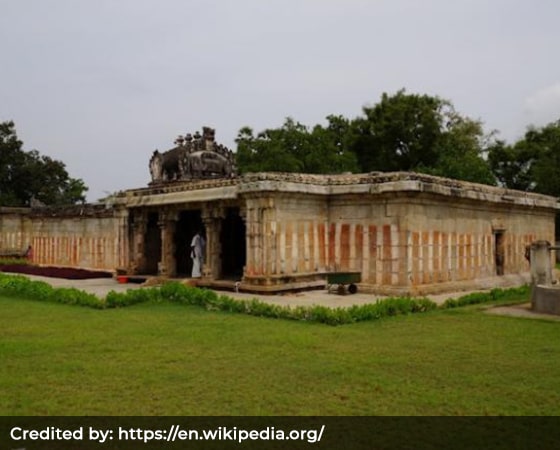
The Gudimallam Temple or Parasurameswara Temple is an ancient temple on the banks of the River Swarnamukhi in Gudimallam village, Yerpedu Mandalam, Chittoor, Andhra Pradesh. The Archeological Society of India has been maintaining it since 1954.
According to the legend, Sage Jamadagni, father of Parasurama, suspected his wife Renuka of having unchaste thoughts. So, he ordered his son to behead his mother. Parasurama obeyed his father and severed his mother's head. When Sage Jamadagni wanted to reward his son, Parasurama asked him to bring his mother back to life. As per his wish, she was brought back to life. However, Parasurama could not overcome the guilt of beheading his mother and felt remorse for his act. Other sages advised him to perform penance and worship Shiva at Gudimallam. After many days, he found the Gudimallam Temple in the middle of a forest. He dug a pond there and began his penance.
A single flower blossomed in the pond daily, and Parasurama offered it to Shiva. He appointed a Yaksha named Chitrasena to guard the single flower. Chitrasena was a manifestation of Brahma. However, the Yaksha laid a condition that he must be given daily an animal to eat and a pot of toddy to drink. Parasurama agreed.
One day, when Parasurama went to hunt, Chitrasena wanted to worship Shiva. So, he picked the flower for worship. The enraged Parasurama fought with the Yaksha when he found the flower missing. When the Yaksha struggled for his life, Shiva appeared before them and blessed both with their desire for Sayujya Mukti, merging with Shiva. Thus, Brahma as Chitrasena, Vishnu as Parasurama, and Shiva as the Lingam formed the Gudimallam Shiva Lingam.
The sanctum of the Gudimallam Temple gets flooded by the River Swarnamukhi every 60 years. The last flood occurred on December 4, 2005. Chandragiri kings administered the Gudimallam Temple for some years. Later, Muslim rulers destroyed it.
According to the inscriptions in the Gudimallam Temple, a Shiva Linga was found between the 1st and 2nd centuries BC. The Pallavas, Vijayanagara kings, and Cholas built and renovated the temple in 1126 AD. Several rulers contributed to the Gudimallam Temple, which features a blend of Chola and Pallava architectural styles. A Dhwaja Sthambam, Bali Peetam, and a Nandi idol are at the entrance. The presiding deity of the Gudimallam Temple is Parasurameswara Swamy, an incarnation of Shiva. He graces the sanctum in the form of a hunter in human form. The hunter form is believed to be the manifestation of the Hindu Trinity - Brahma manifests at the bottom, Vishnu at the middle, and Shiva on top. The sanctum is in the shape of a yard flower.
Parasurameswara Swamy faces east and is 7 feet high. He is made of dark-colored stone. His torso resembles the shape of a bull's head. He has well-built broad shoulders, a narrow hip, and toned abdominal muscles.
Parasurameswara Swamy has two hands. His right hand holds the legs of a lamb (upside down) and a pot in his left hand. He carries an ax on his left shoulder. His hair is a bunch of penitential plaits, and his ears are like leaves with kundalas. Sarapali (neck jewelry) adorns his neck, and he wears a hip belt around his waist. The deity sits on the Amara Purusha with folded knees, and Amara Purusha's body appears shrunken. His face shows tight teeth.
The sanctum has a false ceiling over wooden joints. It is at a lower level, and the two Mandapams before the sanctum are at an elevated level. Hence, the temple became known as the Gudimallam Temple or 'temple at the pit'. The idol of Parasurameswara Swamy is openly set up within the square base surrounded by three railings on slabs.
The sun's rays directly fall on Parasurameswara Swamy's forehead through the grill carved on the stone walls in the north and south. The Chandragiri Fort Museum offers more information about the Gudimallam Temple.
The Gudimallam Temple has shrines to Vinayagar, Sri Anandavalli, Sri Valli Devasena Subramanya Swamy, Surya Bhagawan, Dakshinamurthy, Chandikeswarar, and Durga. Parvati, Shiva's consort, has a separate shrine in the courtyard. There is also a garden and a well inside the Gudimallam Temple.
A huge Peepal Tree is outside the temple, under which people worship the idols of Naga Devatas. The temple's holy bull is tethered at the entrance.
The Gudimallam Temple grandly celebrates Ugadi, Maha Shivaratri, Navaratri, Arudra Darshan, and other Hindu festivals.
People with marriage and pregnancy problems visit the Gudimallam Temple, believing that performing Abishekam to Parasurameswara Swamy can remove their hurdles and fulfill their wishes.
Renigunta bus stand is at a 16 Km distance.
Renigunta Railway Station is the nearest, at 17 Km.
Tirupati Airport is 17.4 Km away.
The Gudimallam Temple is open from 6.00 am to 8.00 pm.
If you wish to have customized spiritual tours or pilgrimages arranged in India for yourself or for a group of people, please contact Brindavan Mystic Services
Email ID: [email protected]
Toll free: 1800 102 9098
