 The item has been added to your cart.
Click the 'Play' button to read out loud this webpage content
The Idaichuranathar Temple lies 60 kilometers away from Chennai. It lies on a path between Chengalpattu and Thirupporur. The temple lies 18 kilometers from Thirupporur and 9 kilometers from Chengalpattu. The main deities housed in the temple are Sri Idaichuranathar, also called Sri Gnanapureeswarar, and his consort Sri Govardhanambikai.
The Idaichuranathar temple was built in the 7th century. It lies in a beautiful, hilly location. The temple lies in a village, presently called Thiruvadisoolam. The village is in a scenic location between two hills and hence is also called Idaichuram(a place between hills and forests).
This temple is the 27th of the 32 Tevara Sthalams in the region of South India.
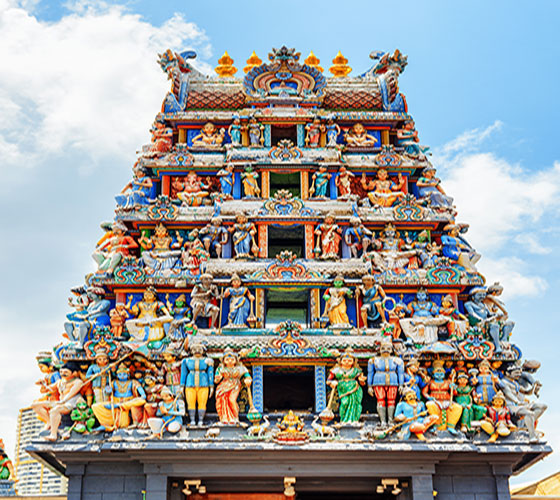
This temple, dedicated to Shiva, was built in the 7th century. There are 15 inscriptions recorded in the temple belonging to the Chola kings and the Vijayanagar kings. The inscriptions mainly record gifts of lands, perpetual burning of lamps, and contributions of Kulothunga Chola. The ancient temple is around 2000 years old and was built in the Chola period. The inscriptions date back to the Chola kings and the Vijayanagar kings.
The child saint, Thirugnanansambandhar, was on a pilgrimage to Shiva temples. One day, he felt tired and hungry. It was noon and very hot. The Saint decided to rest under a tree. A young shepherd in a loin cloth approached him with a pot of curd. He offered Thirugnanasambandhar the curd and asked his identity. The Saint explained that he was visiting the temples of Shiva. Stating that Shiva was present at the spot, the shepherd coaxed the Saint to sing in his praise. The Saint was doubtful, and he followed the young boy, who went up to a nearby tank and then disappeared with a smile. Shiva had granted the child saint a Darshan (vision). Thirugnanansambandhar, realizing who the shepherd was, sang ten verses in his praise and called Shiva Idaichuranathar, Idai (came and left mid-way).
The sages Gowthama and Sanath Kumara also worshipped Shiva at this spot.
Another legend has it that the region was a dense forest covered with Vilva trees. Cows grazed in this area. One day, the shepherd noticed that one of the cows was not giving enough milk. He followed her and saw the cow pour the milk into the thick bushes. He informed the villagers who cleared the bushes and discovered a Maragatha Swayambhu Lingam. The villagers realized that the cow was Parvati, the consort of Shiva, who had come in the form of the divine cow, Kamadhenu. They built a temple housing the deities of the God Gnanapureeswarar and the Goddess Govardhanambikai.
When Shiva went to help the child saint, Thirugnanansambandhar, Mother Ambica wanted to accompany him. Stating that any child can recognize his mother, Shiva advised her to turn back. He wanted to go alone. Mother Ambica was ready to accompany Shiva, and she was seen walking with him. Hence, we see mother Ambica in a walking posture, with one foot forward and one foot backward.
The Moolavar (main) deity is a Swayambhumurthy (self-manifested) Lingam, made of Maragatham tiers. The inner corridors contain the deities of Gods like Varasidhi Vinayakar, Murugan, and his two consorts, Nalvars, Bairavar, Daksinamurthy, Mahavishnu, Brahma, and Goddess Durga.
The outer corridor houses the shrines of Brahmandeshwarara and Brahmandeshwari. The beautiful inner Prakaaram (corridor) is styled with Ahazhi surrounding the sanctum.
At the time of Aarti (worship), one can see the glittering of the Maragatha Lingam. To the right of Shiva’s sanctum is a beautiful relief of Muruga, with his Vel (spear) and his right leg on his mount, the peacock. There are beautiful stone pillared Mandapams in the temple. The temple is ancient and surrounded by serene paddy fields, with green hills in the backdrop.
The Tank where Shiva gave his Darshan to Saint Thirugnanansambandhar still exists and is called Katchi Kulam. (Katchi means appearance and Kulam means Tank). In the outer corridor, there are three trees – Vilva, Neem, and Peepal tree, which are close together. They represent Shiva, his consort Parvati and Vinayakar. The trees signify unity.
The outer corridor has vast space and has a small shrine for Vinayakar. The Sri Valli Devasena Samedha Subramanyar has a shrine here too. The Nandi is in the eastern Prakaaram (corridor) and faces west towards the main deity. In the eastern part of the temple, there is a shrine for the Sun God, Surya.
In the outer corridor, there is a giant Banyan tree gradually engulfing a palm tree.
The devotees believe that the trees in the outer corridor signify unity and unite families. Even ones that are separated get to reunite. Devotees pray here for a cure from disease. The devotees who are facing delays in marriage or concerned with child welfare pray to the sacred trees, offering Vastraas (clothes) and yellow thread. Devotees offer Honey to Shiva for Abishekam(sacred wash). Those with disfigured legs pray to Mother Ambica.
Devotees worshipping Shiva and his consort Parvati in this temple are blessed with Santhana Prapthi (child boon).
The temple celebrates the Maha Shivaratri in the month of Maasi (February-March), which is celebrated in a grand manner. God’s wedding festival is celebrated along with Panguni Uthiram in March-April, Chitra Pournami in April-May, and the Valaikappu (bangle) festival for Mother in July-August, on Aadi Pooram.
Every month, the temple observes Pradosham and Krithigai.
The nearest airport is in Chennai.
The nearest railway station is the Chengalpattu railway station.
Private and government buses ply between Chengalpattu and Thirupporur.
| S No | Temple Pooja Timing | Timings |
|---|---|---|
| 1 | Morning | The temple is open from 8.00 A.M. to 12.00 P.M. |
| 2 | Evening | 4.00 P.M. to 7.00 P.M. |
If you wish to have customized spiritual tours or pilgrimages arranged in India for yourself or for a group of people, please contact Brindavan Mystic Services
Email ID: [email protected]
Toll free: 1800 102 9098
