 The item has been added to your cart.
Click the 'Play' button to read out loud this webpage content
Madukeshwara Temple, or Banavasi Temple, is an important monument in Banavasi, Uttara Kannada, Karnataka. Sri Madukeshwara is the presiding deity of the temple. 'Madhu' means 'honey'. Since the Shiva Linga is honey-colored, the Banavasi Temple is also called Madukeshwara Temple. It is 20 Km from Sirsi, and the presiding deity of the Banavasi Temple is Shiva.
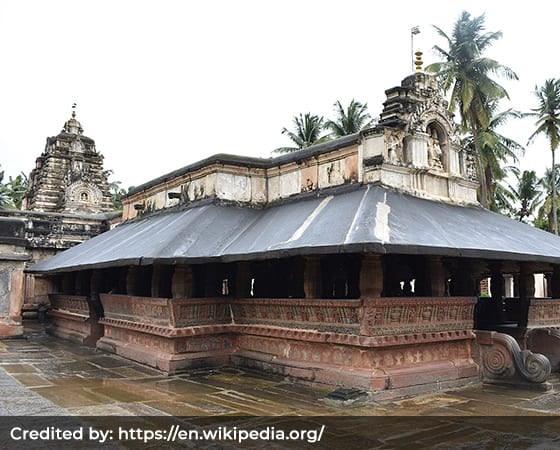
The Kadamba rulers built the Banavasi Temple in the 9th Century. However, it underwent many additions and renovations from the Chalukyas to the Sonda periods. Banavasi was the first capital of Karnataka. Kadamba dynasty ruled most of the Karnataka region between 345 and 545 AD.
Banavasi dates back to 375 A.D. Chinese travellers Huen Tsang, Greco-Roman writer Ptolemy, Kalidasa, and Chamarasa mentioned Banavasi city during their visits. Over the years, Banavasi had many different names: Konkanapura, Nandanavana, Vanavasika, etc.
The foundation of the Banavasi Temple was supposedly laid by King Mayura Sharma. The temple's architecture is now a melange of Sonda, Hoysala, Chalukya, Pallava, and Rashtrakuta styles, and structures were added until the 12th Century.
Banavasi Temple features the Kadamba architecture style and faces the east direction. The Garba Griha is very simple. The ornately carved pillars and the sanctum evoke the style of architecture followed by the kingdoms that ruled Banavasi.
Unlike other South Indian temples, Banavasi Temple has two pillars facing the Mandap of the main shrine. One of them is Deepa Sthambha, the place where lamps are lit. The other one has a stepped pyramidal base. One side of the steps has an idol of Indra facing the sanctum of the Banavasi Temple.
Nandi Mandapa - The Ardhamandapa (Porch) of the Banavasi Temple is followed by a 7 feet high Nandi with a tilted head. One of its eyes looks straight into the sanctum at the Shivalinga. The other eye looks diagonally through the pillars to the nearby temple of Adishakti. There are carved granite pillars surrounding the extensively carved Nandi.
Nritya Mandap - This Mandap was for dance performances by Devdasis or temple dancers. Folklore says that a king tried to distract Sage Allama from his penance by making a Devadasi "Maye" perform a dance before him. She tried to seduce him, but her efforts were in vain. The architecture of the Mandap, with several black stone pillars and benches, evokes a bygone era when dance performances used to take place here.
Adimadhava-Madhusudan - A tall idol of Vishnu is seen on the right soon after one enters the Darshan Mandap. This uniquely carved idol is the main deity of the Banavasi Temple. This Vishnu idol is extremely artistic.
The Madhu (Honey) Linga - The 64-inch Shiva Linga is a honey-colored stone. The unique color of the Shiva Linga attracts thousands of visitors to the Banavasi Temple. Covering the Linga is a silver face that has a human form. The priests can only see and touch the Linga during the morning rituals.
Parvati Temple – Parvati has a separate shrine. Banavasi Temple welcomes both Shiva and Shakti devotees here. During the auspicious Navratri days, she is decorated in different forms for the nine days.
The Temple Courtyard- The entrance and the Anna Daanam Hall: A wide pathway bordered by old-fashioned houses leads to the east-facing entrance of Banavasi Temple. Even though the Gopuram is severely damaged, the twin elephants on each side greet visitors to the temple complex.
Stone Cot - Ten stones are joined together to make a stone cot. King Raghunatha gifted it to the Banavasi Temple. Since then, it has been used during the Kadambotsva and other festivals in Banavasi. The idols are carried on this magnificently carved cot. A lotus is designed on the ceiling of the cot, whereas its pillars have carvings of mythological animals.
Narasimha and Krishna Temples- On each side of the main shrine are the temples of Krishna and Narasimha. Visitors can see some incomplete carvings on the walls of the Krishna temple, which are quite intriguing.
The Banavasi Temple has eight separate shrines for the Ashtadik Palakas, their consorts, and Vahanas (divine vehicles).
The Banavasi Temple celebrates Kadambotsava, a cultural festival, for two continuous days in December. People from across the state, folk dancers, and musical partners participate in this grand festival.
Mahashivratri is another major festival celebrated during February. Madukeshwara Car Festival, held every March, attracts visitors worldwide.
Harishi Bus Stand is 13.5 Km from the temple.
Talguppa Railway Station is the nearest at a 50 Km distance.
Mangalore International Airport is 267 Km away.
The Banavasi Temple remains open from 6.00 am to 1.00 pm and from 4.00 pm to 8.00 pm. The temple offers Anna Daanam to the visitors at 1.00 pm.
If you wish to have customized spiritual tours or pilgrimages arranged in India for yourself or for a group of people, please contact Brindavan Mystic Services
Email ID: [email protected]
Toll free: 1800 102 9098
