 The item has been added to your cart.
Click the 'Play' button to read out loud this webpage content
The Masrur/Masroor Temples is an early 8th-century rock-cut Hindu Temple complex in the Kangra Valley, Beas River, Himachal Pradesh. The Masrur Temples face northeast, towards the Dhauladhar range of the Himalayas. People otherwise know it as Ellora of Himachal and the Himalayan Pyramid. It is now under the maintenance of the Archeological Survey of India (ASI).
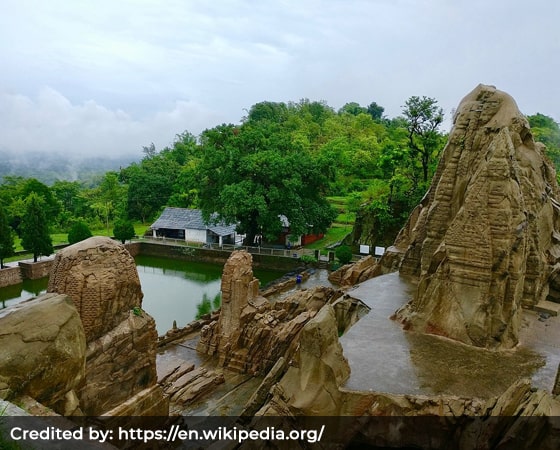
According to the local legend, the Pandavas built the rock-cut temple during their exile. It is believed that as the location and identity of Pandavas were exposed, they shifted from here. It was the reason behind the incomplete structure of the temple complex.
Another interesting story is about the Masrur Temple and its incomplete staircase. It is said that Pandavas constructed the stairs to reach heaven. They promised to complete the construction work by the same morning. Listening to that, Indra wanted to stop them from reaching heaven.
So, Indra disguised himself as a crow and crowed loudly before dawn. As a result, the Pandavas failed to complete the staircase.
It is believed that the Masrur Temple complex was first built by the Pandavas while traveling through these mountains. It belongs to the 7th and 8th centuries. The Katoch dynasty renovated the temple. The Masrur Temple was constructed with natural sandstone rock. It features the North Indian Nagara architecture style. The temple lies on a hilltop at a height of 2,500 feet.
The detailed carvings on the temple wall depict Shiva, Kartikeya, Indra, Surya, and many deities. The Masrur Temple complex is dedicated to Shiva, Vishnu, Devi, and Saura traditions of Hinduism.
Rama, Sita, and Lakshmana murtis were found here during excavation. These idols are installed in the main shrine, though it is a Shiva temple. A group of 15 monolithic rock-cut temples are designed in the Indo-Aryan style. Using monolithic rock, the artisans carved all the temples with Shikharas. The Shikhara of the central shrine has nine stages, each with an Amalaka.
The Masrur Temple has a sacred rectangular pool of water in front of the temple complex. The pool water reflects the image of these magnificent temples. There are three entrances to Masrur Temple - on its northeast, southeast, and northwest sides. Two of them are incomplete.
The entire temple complex is symmetrically laid out on a square grid. The main sanctum of the Masrur Temple has a square plan and the Mandapa. There are reliefs of major Puranic deities. The steps in the rock lead to the storehouse, where people can see some broken idols
The Masrur Temple's style is similar to the styles of the Ellora and Mahabalipuram Kailashnath temples.
The Masrur Temple complex is an important venue for several cultural fairs and festivals. Maha Shivratri, Navratri, Lohri festival, and Masrur Mela attract a large crowd of devotees.
The Masrur Mela is a two-day fair held every April. The Lohri festival is the harvest festival celebrated every January. Devotees celebrate these festivals with traditional dances, feasting, and music performances.
Kangra Bus Stand is at a 36.7 km distance.
Nagrota Suriyan is the nearest railway station at 12.1 km.
Gaggal Airport, Kangra, is the nearest airport at a 30.9 km distance.
The Masrur Temples remain open from 7.00 am to 9.00 pm daily.
If you wish to have customized spiritual tours or pilgrimages arranged in India for yourself or for a group of people, please contact Brindavan Mystic Services
Email ID: [email protected]
Toll free: 1800 102 9098
