 The item has been added to your cart.
Click the 'Play' button to read out loud this webpage content
The Jwala Devi Temple, or Jwalamukhi Devi Temple, is a highly revered shrine dedicated to Shakti. It is in the lower Himalayan town of Jwalamukhi, Kangra district, Himachal Pradesh. The Temple lies amidst surging hills and overlooks the Dhauladhar range. It stands at an altitude of 1,737 meters. The Jwala Devi Temple is one of the 51 Shakti Peeths of India.
Jwala Devi, an incarnation of Parvati, presides in the form of flames in the temple. Owing to this fact, she is also denoted as the 'Flaming Goddess.' 'Jwala' means 'flame' in Sanskrit.
There are interesting legends about the Jwala Devi Temple. According to a legend, once, a cowherd found that one of his cows always had no milk. He started following the cow to know the actual reason. He saw a girl coming out of the dense forest after drinking the cow's milk and disappearing. He told the entire story to the king. But the king knew Sati's tongue had fallen in the area. However, he was not able to find the exact spot.
After some years, the cowherd informed the king about the sight of burning flames in the mountain. Finally, the king found the right spot and erected the Jwala Devi Temple. He engaged priests to worship the deity regularly.
Another legend explains that during Akbar's rule, he learned about the legend of the Jwala Devi Temple. He tried to extinguish the flames with a stream of water. The incredible power of Jwala Devi kept the flames burning. Realizing her power, Akbar came with his army to the Jwala Devi Temple. He presented a gold umbrella (Chatra) for the deity. But while offering it, the gold in the umbrella turned into an unknown metal. It was said that the deity failed to accept his offering.
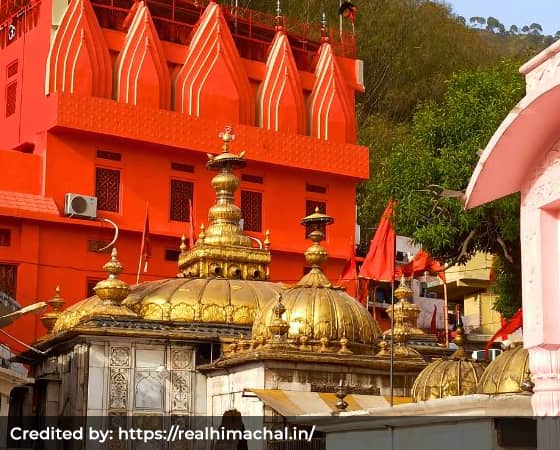
The Jwala Devi Temple follows an Indo-Sikh architectural style. Raja Bhumi Chand Katoch of Kangra is believed to have built the temple. Ghazni Muhammad looted the temple in 1009. Later, the King of Nepal extended it with a huge Mandap and donated a big bronze bell.
It is built on a wooden platform with a small dome. Inside the temple is a central square pit where the eternal flames burn. There are a few more pits in front of the flames where the flowers and other offerings are kept.
Ranjit Singh, the King of Punjab, visited the place in 1813. He renovated the Jwala Devi Temple and covered its tower with gold. The king also donated silver doors to the temple. The temple’s modern building has a golden dome, pinnacles, and a beautiful silver-plated folding door. Maharaja Kharak Singh presented this to the temple. In 1815, Maharaja Ranjit Singh, father of Maharaja Kharak Singh, presented the golden roof.
During the 1870s, the Government of India appointed a foreign company to explore the possibilities of finding big natural gas reservoirs there. But they could not find anything.
Nine eternal flames in the Jwala Devi Temple represent Maa Chandi, Mahakali, Hing Laj, Annapurna, Mahalakshmi, Vindhya Vasini, Ambika, Saraswati, and Anjana.
Gorakh Dibbi and Chaturbhuj temple are other small shrines inside the temple complex.
The Jwala Devi Temple organizes grand fairs twice a year, on the occasion of Navratri during Chaitra (March-April) and Ashwin (September-October). Thousands of devotees visit the temple during these occasions to pray and receive the blessings of Jwala Devi. Navratri and other Hindu festivals are celebrated in the Jwala Devi Temple.
Shringar Aarti, Mangal Aarti, Madhyayan Kaal Aarti, Sayan Kaal Aarti, and Shaiyan Aarti are five types of Aarti performed to the deity. The Shaiyan Aarti is carried out at the Jwala Devi Temple before bedtime. The deity is embellished with beautiful dresses and valuable ornaments during the ritual. The priests perform prayers in two parts- the first part is in the main temple, and the other is in the Sejabhawan, where they recite slokas from 'Saundarya Lahiri.'
It is believed that people suffering from the afflictions of witchcraft and black magic effects can get relief by performing Tantrik Yantra Poojas in the Jwala Devi Temple. Devotees offer milk and water to the deity as their prayer commitment.
The Jwalamukhi Bus Stand is 0.5 km away.
Jwalamukhi Railway Station is at a 20.8 km distance.
The Kangra Airport is 44.3 km from the temple.
The Jwala Devi Temple remains open from 5.00 am to 10.00 pm in summer and from 6.00 am to 9.00 pm in winter.
If you wish to have customized spiritual tours or pilgrimages arranged in India for yourself or for a group of people, please contact Brindavan Mystic Services
Email ID: [email protected]
Toll free: 1800 102 9098
