 The item has been added to your cart.
Click the 'Play' button to read out loud this webpage content
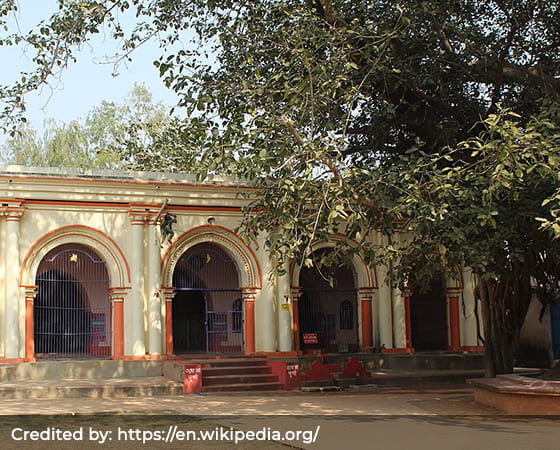
The Mrinmoyee Temple is the oldest temple dedicated to Durga in Bishnupur, Bankura district, West Bengal. It is rich in heritage and part of the Rajbari premises. Mrinmoyee means 'made out of mud,' another name for Durga.
According to legend, King Jagat Malla came to Bishnupur with his favorite bird, the falcon, to hunt deer. While chasing a deer, the king lost his way.
While resting under a banyan tree, the king heard a woman's voice. She instructed him to shift his capital here and to dig the ground. She said that he would find a tiny remnant of her face, and asked him to construct a temple for her in that spot.
Following her words, the king relocated his capital from Pradyumnapur to Bishnupur in 994 CE. On digging the ground, he found the tiny relic of her face. Some clay was brought from the River Ganga, and that small piece of the deity was incorporated into the statue of Mrinmoyee. Within three years, the king constructed the Mrinmoyee Temple. The temple conducted its first Durga Pooja in 997 CE.
King Jagat Malla built the temple in 997 AD. The Mrinmoyee Temple features Bengali-style temple architecture with the Dalan style. It has a flat roof with heavy cornices and S-curved brackets. The sanctum enshrines Goddess Durga in the name of Mrinmoyee. She is depicted with a demon under her feet, representing the victory of good over evil. The clay idol of Durga is an old idol. Ganesh, Lakshmi, and Saraswati shrines are also here. Although the Mrinmoyee Temple had undergone extensive renovations, the idol made of Ganga clay remained the same.
This Mrinmoyee Temple is famous for its 15-day Durga Pooja. The 63rd generation of the Bishnupur royal family carries forward the customs of the Durga Pooja. Other temples in Bishnupur do not start their worship until the torch is lit from here. It has a cannon, and the priests fire it to mark the start of the Ashtami of Durga Pooja. They fire it thrice daily for fifteen days.
The temple's Durga Pooja is popular in West Bengal and is the major festival of the Mrinmoyee Temple. The festival starts by worshipping "Baro Thakurani," "Mejo Thakurani," and "Choto Thakurani" after setting up a clay pot or Ghat. At the sacred moment of "Mahashtami—Sandhipooja," a cannon is fired, and priests sacrifice vegetables to the deity.
This Pooja ceremony of the Mrinmoyee Temple is distinctive. They carry a manuscript called 'Balinarayani Puthi,' and the hymns differ from conventional chants.
On Krishna-Navami (a week before Navratri), the Boro Thakurani enters the sanctum of the Mrinmoyee Temple.
In the morning, Boro Thakurani's Patachitra is brought under an umbrella. A ghat (clay pot) is also established. Rajmata Alpana Singha Thakur leads the ladies of the Royal family, and they offer prayers by daubing vermilion on the Patachitra to mark the beginning of Durga Pooja in Bishnupur.
Mejo Thakurani reaches the Mrinmoyee Temple on Chaturthi, the fourth day of Navratri, while Chhoto Thakurani reaches on Shashti, the sixth day of Navratri. Once everyone has arrived, the temple's gates are open to the public.
Boro Thakurani represents Mahakali, while Mejo and Chhoto Thakurani symbolize Maha Lakshmi and Maha Saraswati. According to sacred scripture, Goddess Durga manifests herself in three forms: Mahakali, Maha Lakshmi, and Maha Saraswati.
Sandhi Pooja on Ashtami is another unique feature of the Durga Pooja. An hour before dusk, an eight-armed idol of Vishalakshi (an aspect of Gauri) arrives at the inner sanctum. The temple priests use eight urns of water to complete the deity's holy bath (annual bathing).
The bathing tradition continues with the musical performance, which Malla Maharaja Raghunath Singh Deo II started in the 17th century. Subsequently, Rajanjali, the divine offering ritual, is performed with the gold-plated Champa flower. Once again, the mighty guns roar during the sanctification of Sandhi Pooja.
At the end of the ceremonies, the priests do not immerse the idol or the Patachitra. The ancient paintings are securely stored and redrawn the following year.
Bishnupur bus stand is at a 2.4 Km distance
Bishnupur Railway Station is 4 Km away.
Netaji Subhash Chandra Bose Airport is the nearest, at 138 Km.
The Mrinmoyee Temple is open daily from 6.00 am to 6.00 pm.
If you wish to have customized spiritual tours or pilgrimages arranged in India for yourself or for a group of people, please contact Brindavan Mystic Services
Email ID: [email protected]
Toll free: 1800 102 9098
