

 The item has been added to your cart.
How Do Spiritual Beliefs Influence Pongal Festival Celebrations?
 On January 13, 2026
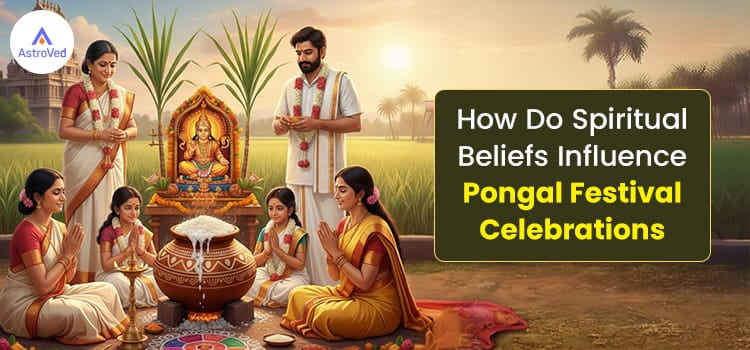
Pongal is a Tamil festival celebrated on the first day of the Thai month (mid-January) as per the Tamil Calendar. It is the day when farmers celebrate the warmth and kindness of the Sun, who is pivotal to their harvest. To acknowledge the bounty of the year that brings in prosperity, the lady of the house sets the fire to an earthen pot containing rice and milk. The mixture is allowed to boil and cool and also overflows. In Tamil, pongal is used for both overflowing and the rice pudding dish made on this day. Farmers celebrate Pongal in a joyous way as a thanksgiving to the Sun God. This festival is celebrated by millions of the Tamil-speaking population across the world.
Spiritual Significance of the Pongal Festival
There is also a spiritual significance to the Pongal festival. It marks the beginning of Uttarayana - a time when the Sun reverses his path from Southward to Northward (Uttara) Direction. On the same lines, Pongal indicates a time when one must turn our aspirations from outward to inward.
Immortality and an End to Sorrow
As per the Katha Upanishad, anyone who has turned his eyes inward (avritta chakshu), takes a U-turn because he wants to attain immortality (amrutatvamicchan). This Upanishad also explains that immortality is nothing but the opposite of sorrow. In order to avoid sorrow, we need to turn our gaze inwards.
Buddha, the enlightened one, defines enlightenment as an end to all sorrow and the method to do this is by clearing our vision. The solution to every sorrow does not lie outside; it lies in finding it through inner training.
Desires and Mental Impressions as Obstacles
Just like the telescope that helps us magnify and see things more clearly than the naked eye, sorrow can only be removed when we turn our mental telescope inward we can get clarity. When we look through a telescope, if the position of the lenses or the direction of view is not correct, the image looks distorted. Similarly, our desires and mental impressions create obstacles that may prevent us from seeing our inner selves.
In general, sorrows occur when our mind makes up mental impressions and reality is not in line with them. Whenever we react to a particular situation in our lives, the impression is stamped on our minds and can be revisited later, causing happiness or sorrow.
The Chain of Karma
If X gets angry with Y, then Y gets an opportunity to retaliate; this is the Law of Karma. If Y gets angry with X, this reverses and can go on as an unending chain of actions and reactions. This chain can never be broken as action is never stopped.
As per the Bhagavad Gita, actions cannot be controlled, but it is possible to control our reactions. If X gets angry with Y, Y has the option of not reacting to X. When a rich man abused Buddha for begging, Buddha remained silent. The rich man wondered and asked why he did not reply. Buddha calmly replied that if a gift is not accepted, it returns to the one who gave it. Similarly, if an act of abuse is not accepted by the Buddha, it is returned to the rich man. So, the chain of karma can be broken only by stopping your reactions.
Importance of Selfless Work
When we do selfless work, it is the only sure and pleasant way to overcome the effects of karma. So, what is selfless work? It is an action taken without attachment or for reaction. For example, if you donate food to a poor person who has nothing to offer in return, then you are doing a selfless action. If you are gifting something to your boss, expecting them to give you a good increment or better position, then it is a selfish action.
The Dissolution of Ego
In this era, we think of the ego as another individual that controls our thoughts and actions. But the ego can be dissolved only when you separate it from yourself. When you consider God, the world and yourself as one, there is no place for ego. When there is no ego, sorrow can no longer exist as we feel sad only when we lose something that we are attached to. When we have nothing to lose, we will not have any sorrow.
King Janaka mentions that he has no wealth and hence he should be considered the richest man in the universe. When you consider that you do not own anything, there is no question of losing anything or sorrow on losing it.
The Inner Discovery
The spiritual meaning of Pongal is in realising that our thinking is what makes us good or bad. The world does not change for an individual. When we view the telescope of life from the right end, we can get a clear view and be blessed by the divine. The spiritual significance lies in the great discovery that Pongal is the overflowing of divine joy and the festival is the right time to understand it.


