

 The item has been added to your cart.
Hanuman Chalisa: 5 Life-Changing Lessons Hidden
 On December 12, 2025
Hanuman
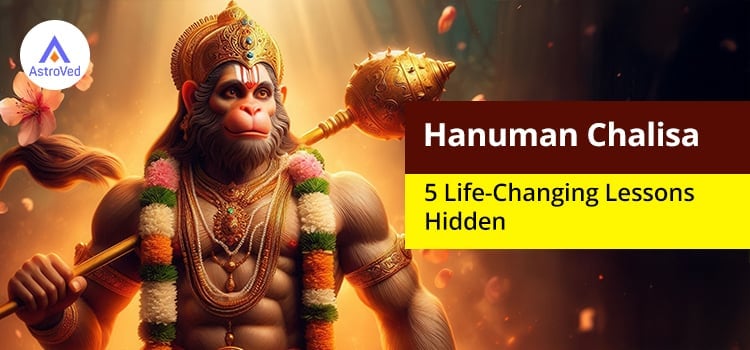
Hanuman is a mighty God. Believed to be the divine son of the Wind God Vayu and an incarnation of Shiva, he was an ardent devotee of Rama. He was a rare combination of both physical and mental strength, courage, scholarship, humility, and devotion. He performed many miraculous feats, as detailed in the epic Ramayana, and is hailed as the great protector and bestower of many virtuous qualities and of victory.
Hanuman Chalisa
Hanuman Chalisa is a composition of 40 verses in praise of Hanuman. Composed by Saint Tulsidas, this remains a highly regarded devotional composition, widely recited in temples and homes. It is believed that chanting it with faith can earn the grace of both Rama and Hanuman and bless devotees with many beneficial blessings.
Here, let us briefly look at the 5 Life-Changing Lessons contained in Hanuman Chalisa, learning from which can do immense good to us.
1.Strength should go with HumilityHanuman remains a symbol of incredible strength and self-effacing humility. Hanuman Chalisa highlights this aspect and stresses the significance of combining strength and humility.
Hanuman was mighty. We learn from the Ramayana that Hanuman performed miraculous feats, such as flying over and crossing the massive ocean and lifting and carrying a huge mountain across land and sea. But neither his power nor his accomplishments gave him even an iota of pride. Instead, he was extremely humble and was not even conscious of his prowess; he had to be reminded by others of his strength and capabilities. This humility is one of the reasons that impressed Rama deeply, brought him very close to Rama, earned his love and affection and made Rama accept Hanuman as his foremost devotee.
Thus, Hanuman demonstrates that a person can be truly powerful only when he is strong and also humble, and directs his capabilities towards the greater good rather than personal gratification.
2.Courage should combine with DeterminationHanuman is regarded as an embodiment of valour and remains a symbol of resolute endeavour. Hanuman Chalisa brings out these enviable traits of Hanuman by recounting the incredible deeds he performed, such as leaping over the ocean to reach Lanka when he went in search of Sita and bringing an entire mountain to save Lakshmana's life during the final battle with the demon Ravana and his forces.
Hanuman was not cowed down by threats or challenges, some of which seemed even insurmountable, but went on to face and overcome them with a steely resolve, tenacity and fortitude.
These provide us with powerful lessons on bravery and determination; that belief in oneself, combined with tireless striving, can overcome even seemingly impossible challenges.
3.Faith Moves MountainsWhen a group of monkey warriors, which included Hanuman, went searching for Sita, they landed at what seemed to be the end of the landmass. And in front of them lay a massive sheet of water, the vast ocean, stretching for quite a long distance. This ocean had to be crossed to reach the island of Lanka, where Sita was held captive by the demon Ravana. When those in the group stood on the seashore, thoroughly disheartened and overwhelmed by the enormity of the task, only Hanuman took on the onerous challenge and accomplished the mission. Similarly, when Lakshmana was felled unconscious by a mighty arrow, it was Hanuman's faith that gave him the power to bring a mountain from far and revive the fallen warrior, using the herb found in it.
Hanuman Chalisa repeatedly highlights such an unwavering faith and the power to achieve the impossible. We learn that genuine trust in oneself can help take on obstacles, difficulties and blocks and bestow the strength to persevere and triumph over the challenges life throws at us.
4.Purity in IntentionHanuman Chalisa, citing Hanuman himself, lays great emphasis on the need for one's thoughts to be pure and asserts that only then can words and deeds achieve their purpose. Thus, pure heart and pure intention are prerequisites for a pure purpose, positive action, achieving the intended result and growth, in both worldly and spiritual spheres.
5.Service is service only if it is SelflessHanuman stands for selflessness. We learn from Hanuman Chalisa how devoted he was to Rama and how he wanted nothing but Rama's welfare at the core of his heart. There was not even an iota of selfishness in him or in whatever he did. All his efforts, as described in detail in the epic Ramayana, carried this stamp of dedication and thus remain only as selfless service.
Thus, a sense of fulfilment can flow only from devotion to an exalted purpose that has only others' welfare as its core.


