

 The item has been added to your cart.
Importance of Thaipusam
 On January 19, 2026
India displays its richness through its diverse festivals, each with its own traditions. These festivals bring people together through colors, light, and happiness, as positive moments for everyone. Some important festivals include Thaipusam, which is practiced by the Tamil communities during the full moon day occurring in the month of Thai, which falls in January or February.
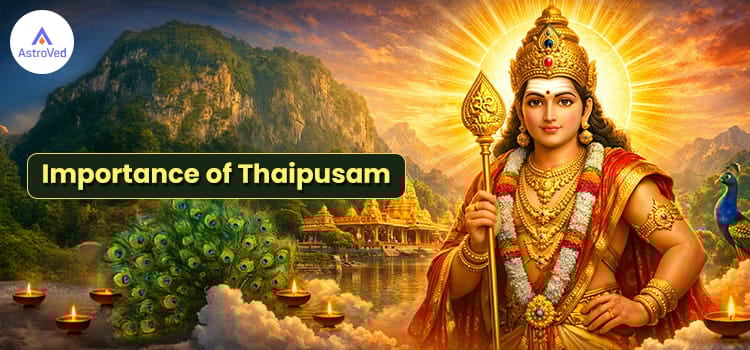
This holy festival is set to the Pushya star, referred to as Poosam in Tamil and Pooyam in Malayalam. Communities in Kerala also celebrate this occasion as Thaipooyam. The festival extends beyond India's borders, reaching Tamil populations in Sri Lanka, Singapore, Malaysia, Mauritius, South Africa, Canada, and several Caribbean nations.
The name Thaipusam is a combination of two things: Thai, which is the name of the month, and Pusam, representing the star. It is at this time that the Pushya star reaches its highest position in the sky, considered very auspicious for worship and devotion.
History of Thaipusam
Thaipusam celebrates the triumph of Lord Subramaniam over the demon Soorapadman and his brothers. According to Hindu belief, Goddess Parvathi handed Lord Subramaniam a strong spear called Vel to defeat these evil forces. The triumph epitomizes an endless war between good and evil, light and darkness. Devotees worship Lord Murugan, another name by which Lord Subramaniam is known, asking for his blessings to rid their lives of evil influences. This god stands for virtue, courage, youth, and beauty.
Special worship is offered in temples on this day. Processions are also held in the streets as people assemble to offer their prayers and sacrifices. Although some devotees regard Thaipusam as Lord Murugan's birthday, others claim Lord Murugan was born on Vaikhasi Vishakam during the Vaikashi month.
What is the Significance of Thaipusam
Thaipusam is a day of atonement and thanksgiving. The devotees thank Lord Muruga, also known as Skanda or Karthikeya, for answering prayed-for desires. Many also feel strongly that, to receive blessings, it is mandatory to atone for past mistakes and wrongs.
When prayers are answered, the devotees swear to bear the kavadi for one, three, or five years. The devotees make these promises after certain events in their lives. Parents pray for their kids, students pray for success, while businessmen pray for prosperity, and the sick pray for their healing. The festival represents faith, sacrifice, and spiritual renewal.
When is Thaipusam 2026?
Thaipusam 2026 falls on Sunday, February 1st. The sunrise time is 7:03 AM, and the sunset time is 6:22 PM. The Poosam Nakshathram timing, which is the auspicious timing for the event, would commence at 1:34 AM on the 1st of February and would continue until 11:58 PM on the same day.
The Sacred Kavadi Attam
Kavadi Attam is a very deep form of worship. Kavadi Attam is a form of fusion between dancing, prasad, and self-sacrifice and has a very high spiritual significance. Kavadi is a semi-circular structure that has a picture of Lord Murugan, fresh flowers, feathers of peacocks, and other colorfully decorated items on which the devotees bear on their shoulders during nadai payanam, a form of walking on their bare feet to the temple.
These spiritual journeys can last over a week, depending on temple locations.
The Palani Murugan temple attracts many pilgrims seeking healing. There is a legend that the ancient Siddhar Bogar made the statue for the temple from very powerful Siddha medicines. Devotees attach the elaborate kavadis to their bodies through the use of sharp skewers to represent the difficulties that come with life. The biggest kavadi used is referred to as the vel kavadi and involves the use of 108 tiny spears to be able to penetrate the kavadi into the skin. Devotees use the tongue and the face in piercing through sharp objects that resemble knives to reach the cheeks of the devotees. Tongue piercing is used to denote the denial that the devotees undergo concerning the gift of speech.
The Preparation and Rituals Performed During Thaipusam
Preparation begins 48 hours prior to the festival through fasting and prayer. Kavadi bearers observe strict practices, abstaining from sexual acts and consuming only pure vegetarian food. They bathe only in cold water. The devotees sleep on the floor. All these practices act as a form of discipline. They offer their hair to Lord Murugan before beginning temple pilgrimages.
Carrying milk pots represents the simplest kavadi form. The more extreme forms include the use of vel skewers in piercing the skin. The piercings are all with the intention of reminding oneself of Lord Murugan and are done in such a way as to prevent the individual from uttering words, requiring extreme endurance and strength. When devotees reach the temple, they set up their kavadi and then shower honey and milk on the deities as an expression of gratitude. They present yellow fruits and flowers to Lord Murugan. Medical implements are removed immediately, and wounds are treated with hot ash. Remarkably, devotees show no pain, bleeding, or scarring afterward, strengthening their belief in Lord Murugan's divine power.
The Eternal Message
Thaipusam 2026 continues this ancient tradition of devotion, sacrifice, and spiritual transformation. The festival reminds everyone about faith's power and the importance of gratitude. Through their extreme acts of devotion, followers demonstrate that true belief transcends physical pain and hardship. This celebration inspires communities worldwide to embrace their spiritual heritage while seeking blessings for better futures.


